

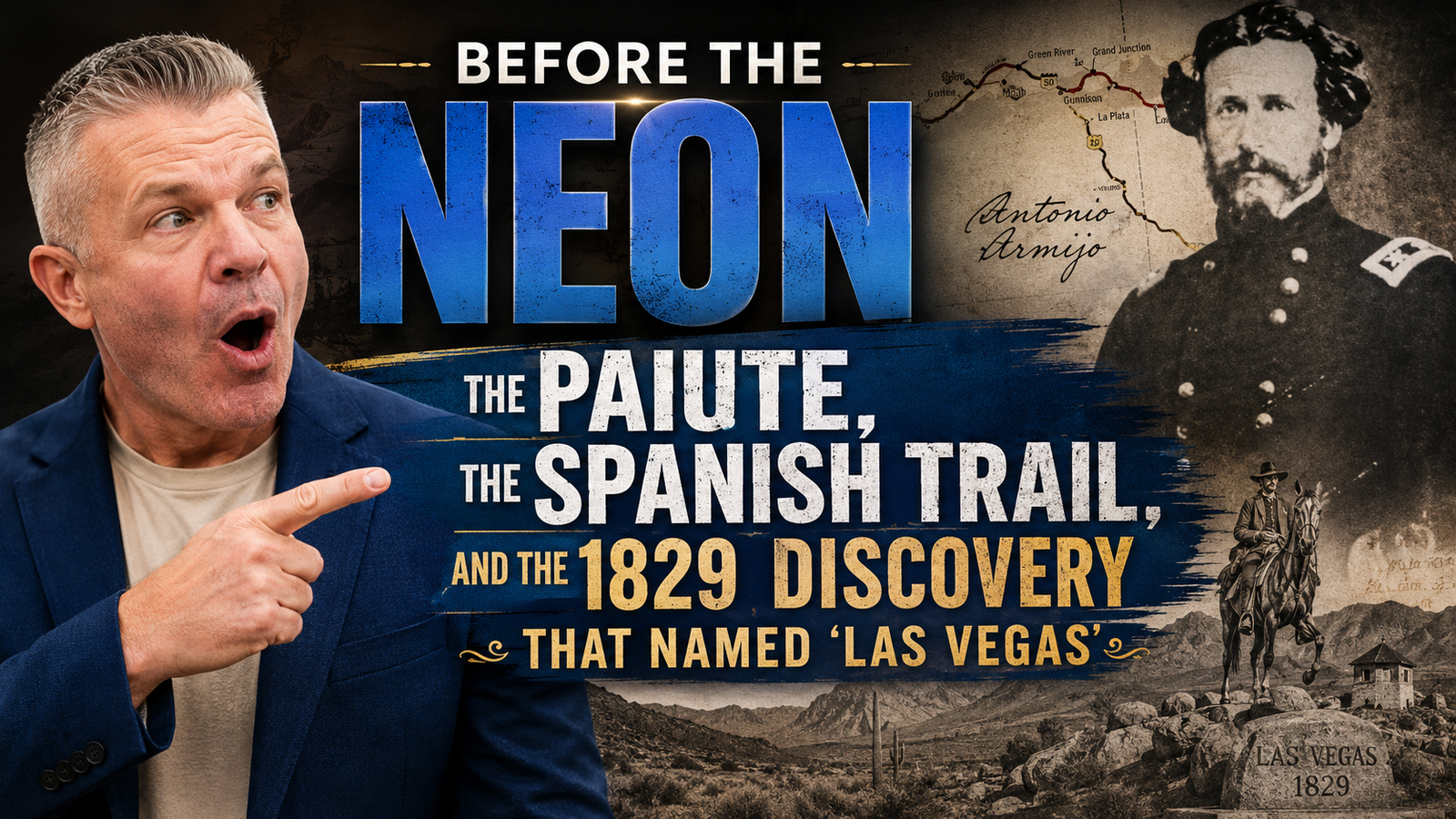
Before the Neon: The Paiute, the Spanish Trail, and the 1829 Discovery That Named 'Las Vegas'
In 1829, a Spanish trader named Antonio Armijo was pushing a mule caravan through the Mojave Desert — somewhere between Santa Fe and Los Angeles — when his scouts stumbled onto something that almost certainly saved lives: green. Actual green. Grass and willows fed by natural artesian springs bubbling up from a desert wash. Armijo wrote the location into his journal with two words: *Las Vegas* — the meadows.
That wash, that water, those two words. That's where Las Vegas actually begins.
The People Who Were Already Here
Armijo didn't discover an empty valley. By the time he camped at Las Vegas Wash in 1829, people had been living in and moving through this basin for hundreds of years.
Archaeological evidence points to at least three distinct groups who left traces in the valley floor and surrounding Spring Mountains: the Ancestral Puebloans (historically called the Anasazi), the Mohave (also known as the Yuman people, whose territory stretched along the Colorado River corridor), and the Southern Paiute, who became the valley's most enduring inhabitants. What's striking is that these groups appear to have overlapped here — sharing, competing over, or simply coexisting near the same water source at roughly the same period of time.
The Southern Paiute understood the valley's geography better than anyone who came after them for a very long time. They knew which springs ran year-round, which desert routes connected water to water, and how to live sustainably in a place that looked, to European eyes, completely inhospitable. Las Vegas Wash — the same spring-fed corridor Armijo would later record — was part of a network of reliable water that made the valley not just survivable but genuinely livable.
That knowledge of water didn't disappear. It shaped every major decision made in this valley for the next two centuries.
The 1829 Stop That Changed Everything
Armijo's 1829 expedition was a commercial mission — he was scouting and opening a viable overland trade route from Santa Fe, New Mexico to the California coast, what would become known as the Old Spanish Trail. The route through the Las Vegas Wash wasn't a dramatic discovery in the gold-rush sense. It was a logistical one. He found water in a place where water was the difference between a successful crossing and a catastrophic one.
The name stuck because the place mattered. Caravans traveling the Spanish Trail through the 1830s and 1840s stopped at the same wash, the same springs, for the same reason Armijo did: it was one of the only reliable water sources on one of the most punishing stretches of trail in North America.
The meadows were real. The water was real. And because of both, Las Vegas became a place people returned to — long before anyone imagined a casino, a resort, or a Strip.
Mormons, Adobe, and a Man Named Octavius Gass
The next chapter came fast. In 1855, members of the Mormon Church established a small mission in the valley — not as a permanent settlement in the modern sense, but as a waystation: a place to teach the gospel to the Southern Paiute and to create a resupply point between Utah and California. They built a 150-square-foot adobe fort along Las Vegas Creek, which fed directly into the Wash. They used flood irrigation to water crops. It was small, it was difficult, and by 1857 the mission had been abandoned.
But the fort stayed.
Enter Octavius Gass — one of those larger-than-life 19th-century frontier figures Las Vegas history tends to forget. Armed with a federal commission, Gass re-occupied the Old Mormon Fort in the 1860s, re-dug the irrigation from Las Vegas Creek, and planted a vineyard. A vineyard. In the Nevada desert. He ran the property as a ranch and trading post — essentially the first real civilian enterprise built on the same water source the Paiute had worked, that Armijo had recorded, that the missionaries had tapped.
The Old Mormon Fort still stands today, tucked just north of Downtown Las Vegas — the oldest non-Indigenous structure in Nevada, and almost nobody drives past it twice.
Why It Matters Today
This isn't just trivia. The reason Las Vegas exists exactly where it does — not five miles north, not over the ridge near Red Rock, not somewhere along the Colorado — is water. Specifically, the artesian springs at Las Vegas Wash. Every decision made in this valley since 1829 has been an extension of that original geographic fact.
When you hear debates today about Lake Mead water levels, conservation mandates, or xeriscaping requirements in newer subdivisions, you're hearing the same conversation the Southern Paiute were having in their own way centuries ago. The desert doesn't change its terms. It just gets more people negotiating with it.
For anyone who lives here — or is thinking about putting down roots here — understanding where the valley came from makes the place feel less like a punchline and more like what it actually is: one of the most improbable, resourceful, and genuinely fascinating cities in North America.
Kirby Scofield has spent decades in this valley, and the history never gets old.
Frequently Asked Questions
Who named Las Vegas and what does the name mean?
Spanish trader Antonio Armijo is credited with giving Las Vegas its name during his 1829 expedition along what became the Old Spanish Trail. He recorded the location of a spring-fed desert wash as *Las Vegas* — Spanish for "the meadows" — referring to the wild grasses that grew there thanks to natural artesian springs.
Who were the original inhabitants of the Las Vegas Valley?
The Southern Paiute were the most enduring Indigenous inhabitants of the Las Vegas Valley, with the Ancestral Puebloans (Anasazi) and the Mohave people also leaving significant traces in the region. These groups appear to have occupied the valley during overlapping periods, all drawn to the same reliable water sources that would later attract Spanish traders and Mormon settlers.
What is the oldest building in Las Vegas?
The Old Mormon Fort, located in what is now Downtown Las Vegas near Las Vegas Boulevard North, is the oldest non-Indigenous structure in Nevada. It was built in 1855 by Mormon missionaries as a 150-square-foot adobe fort along Las Vegas Creek, later reoccupied and expanded by rancher Octavius Gass. It is operated today as a Nevada State Park.