

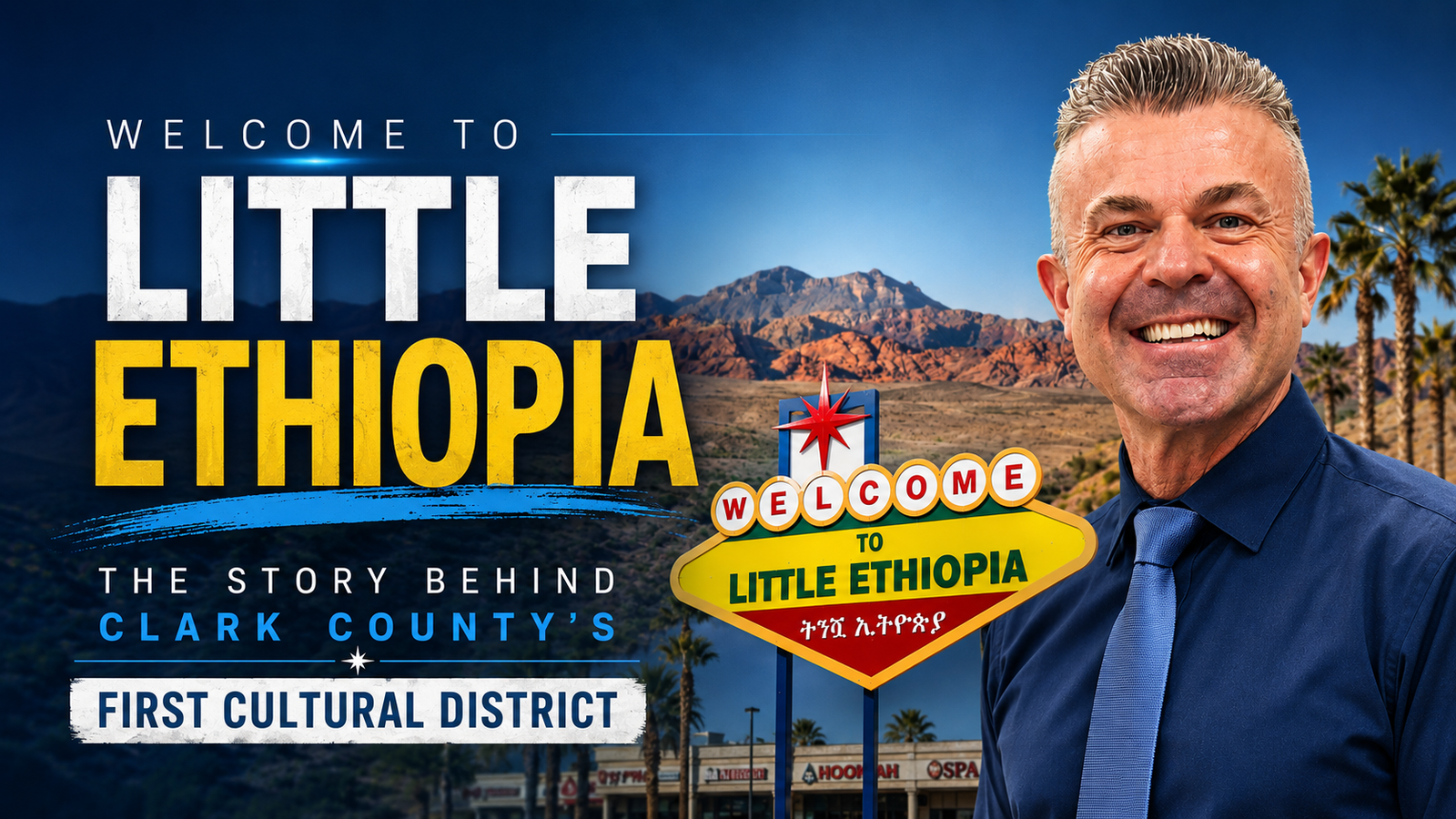
Welcome to Little Ethiopia: The Story Behind Clark County's First Cultural District
A sign went up near Decatur Boulevard, and it looks like something you'd see lighting up the Strip at night — green, yellow, and red, unmistakably Las Vegas in its design. But instead of pointing you toward a casino, it reads: "Welcome to Little Ethiopia."
On a Tuesday morning this year, county commissioners, community leaders, and members of the Ethiopian and Eritrean community gathered at a ceremony to make it official. Then they celebrated outdoors at Clark High School. What they were marking was four years of work, one county approval, and a milestone that no other community in Clark County had ever reached: the valley's first officially designated cultural district.
How Welcome to Little Ethiopia: The Story Behind Clark County's First Cultural District Came to Be
The effort started four years ago, launched by the Ethiopian Community Center of Las Vegas. Girma Zaid chaired the project, which eventually wound its way through Clark County's approval process before landing on the books earlier this year. Commissioner Michael Naft was on hand for the sign unveiling — both the bold, colorful landmark sign and a second, more modest brown-and-white street sign that officially designates the corridor.
The hub sits between Twain and University avenues, anchored by Decatur Boulevard on Las Vegas's west side. It's not a neighborhood most visitors stumble across, and that's part of what makes this story worth telling. Within that stretch, nearly 80 Ethiopian-owned businesses have taken root — restaurants, markets, hair salons, and more — serving a community of more than 40,000 Ethiopians and Eritreans who live across Southern Nevada.
To put that number in perspective: 40,000 people is roughly the population of Boulder City and Mesquite combined. It's a substantial community that has been quietly building something real along this corridor for years, largely off the radar of the broader valley.
What You'll Find There — and Why It's Worth the Drive
The draw for most first-timers is the food. Ethiopian cuisine is communal by nature — dishes served on injera, a spongy sourdough flatbread, with stews and vegetables arranged around it so everyone eats from the same plate. It's one of the more distinctive dining experiences you can have in this valley, and the concentration of restaurants along this corridor means you have real options, not just one token spot.
Beyond the restaurants, the district functions as a genuine community anchor. Markets carry imported goods. Services are offered in Amharic. It's the kind of place that developed organically because people needed it to exist — and now it has the county's formal recognition to match.
The designation also sets a precedent. County officials noted that the approval process for Little Ethiopia lays the groundwork for future cultural districts to receive their own designations. In a valley where the conversation about identity often starts and ends with the Strip, that's a meaningful shift.
Why It Matters for Las Vegas Today
Real estate people talk a lot about neighborhood identity — what makes an area feel like somewhere, rather than anywhere. Cultural districts are one of the clearest answers to that question. They create walkable, recognizable nodes of activity that give a corridor a reason to exist beyond convenience retail and gas stations.
For residents already living near the Decatur-Twain-University corridor, this designation brings visibility and, over time, likely investment. For the broader valley, it's a reminder that Las Vegas is genuinely more layered than the resort economy suggests. The Ethiopian and Eritrean community didn't arrive recently — they've been building here long enough to earn a sign, and a formal one at that.
For anyone who moved here from California or another major metro and misses the kind of authentic, neighborhood-scale dining and culture that dense cities develop naturally, this corridor is worth knowing about. It's the kind of place that makes locals say, "I can't believe I didn't know this was here."
Kirby Scofield and the team at The Scofield Group have sold homes all over this valley — and knowing where these corners of the city actually live is part of what makes local expertise matter.
---
Frequently Asked Questions
Where exactly is Little Ethiopia in Las Vegas?
The Little Ethiopia cultural district is centered near Decatur Boulevard, between Twain Avenue and University Avenue, on the west side of Las Vegas. Clark County's official street signage now marks the corridor, and nearly 80 Ethiopian-owned businesses operate within the area.
What kinds of businesses and restaurants are in the Little Ethiopia district?
The district includes a wide range of Ethiopian and Eritrean-owned businesses — restaurants serving traditional cuisine, specialty grocery markets, and various service businesses. It functions as a community hub for the more than 40,000 Ethiopians and Eritreans living across Southern Nevada.
What is the significance of Clark County's first cultural district designation?
The Little Ethiopia designation is the first official cultural district in Clark County history. Approved by the county after a four-year community-led effort organized by the Ethiopian Community Center of Las Vegas, it also establishes a formal process that future cultural communities in the valley can use to seek their own designations.