

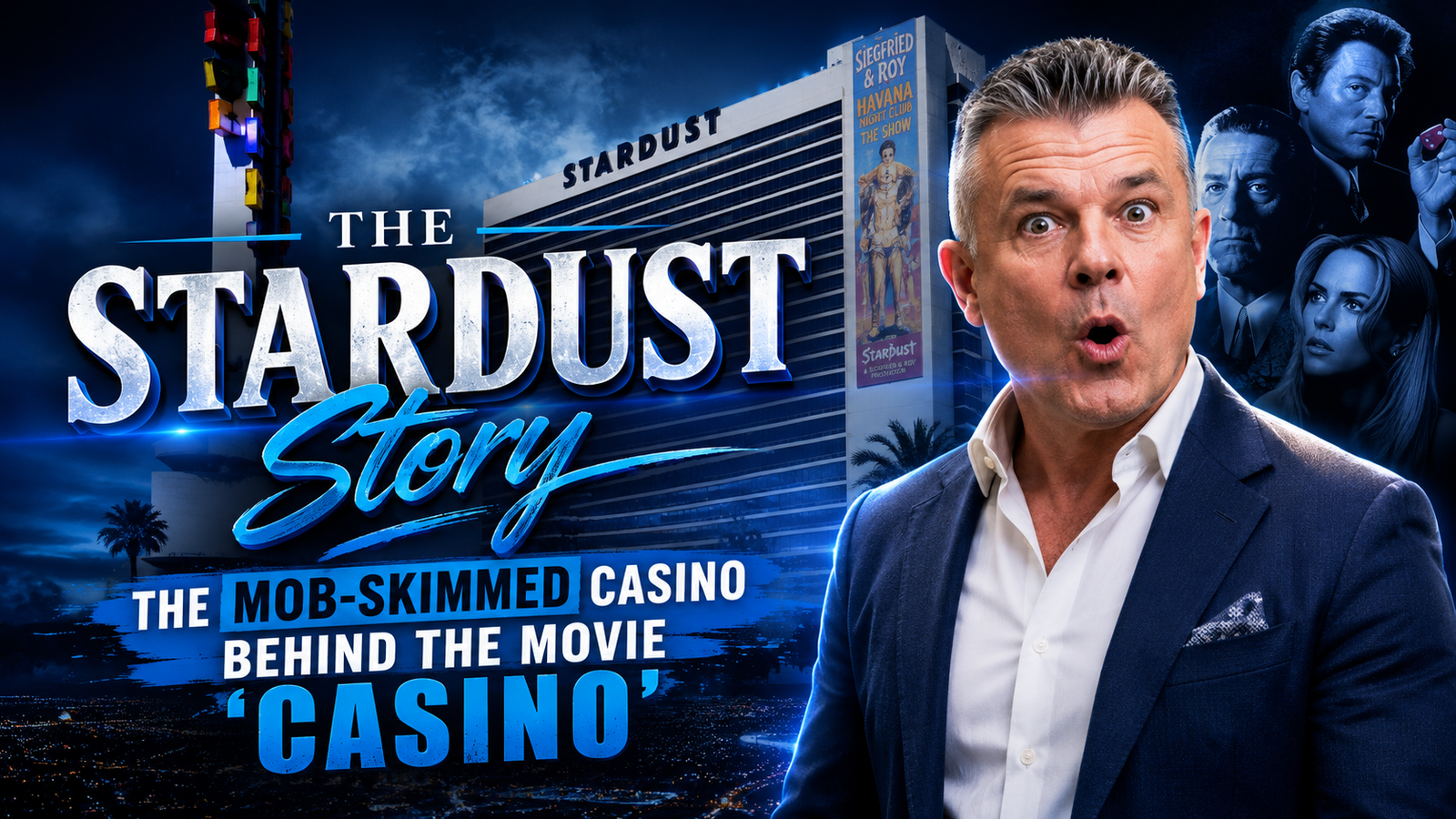
The Stardust Story: The Mob-Skimmed Casino Behind the Movie 'Casino'
On the morning of March 13, 2007, a crowd gathered on the Las Vegas Strip to watch a building die. With a controlled series of charges, the twin towers of the Stardust Resort and Casino folded into themselves and disappeared into a cloud of dust. Forty-nine years of history — some of it glamorous, some of it criminal, all of it quintessentially Las Vegas — vanished in about fifteen seconds.
What had stood there was, at one point, the largest hotel on earth. What happened inside was the real-life template for one of the most celebrated crime films ever made.
The Biggest Hotel in the World — For One Summer
The Stardust opened on July 2, 1958, with 1,032 rooms spread across a low-rise complex on the north end of the Strip. That room count made it, briefly, the largest hotel in the world. The sign alone was a spectacle — a sweeping marquee of planets, stars, and cosmic imagery that became one of the most photographed structures in Nevada. When the neon lit up at night, you could see it for miles.
The resort expanded aggressively over the following decades, eventually growing to more than 1,500 rooms across two towers. It operated the Stardust Country Club off-site and ran the Stardust International Raceway through the 1960s. In 1972, the property became the first Strip resort to open a dedicated RV park for guests — a detail that sounds small but spoke to the Stardust's instinct for capturing every possible type of visitor.
For a long stretch, Lido de Paris — the topless revue imported from the famous Paris cabaret — played to packed showrooms night after night. The Stardust was not shy. It wanted to be the biggest, loudest, most talked-about address on the Strip, and for a while, it was.
The Skim: How Millions Vanished Before the Count Room
Behind the glitter was a financial operation that federal investigators would spend years trying to understand and prosecute. The Stardust was controlled for much of its history by figures connected to organized crime — most notably the Chicago Outfit — and it became one of the most documented cases of casino skimming in American history.
The mechanics were deceptively simple. Before casino revenue was officially counted and reported to Nevada gaming regulators, a portion was quietly removed. Cash walked out of the building, away from taxes, away from regulators, and into the hands of mob bosses in Chicago, Kansas City, and Milwaukee. Estimates of what was taken over the years run into the tens of millions of dollars.
The FBI operation that unraveled the scheme produced indictments that reached deep into organized crime families across the Midwest. The names, the methods, and the sheer audacity of the operation became the basis for Nicholas Pileggi's 1995 book and the Martin Scorsese film *Casino* — with Robert De Niro's character Sam 'Ace' Rothstein modeled on real-life casino operator Frank Rosenthal, who ran the Stardust and several other Strip properties as a front man for the mob throughout the 1970s and early 1980s.
Rosenthal himself was never convicted of a felony in connection with the skimming. He lived in Las Vegas long enough to become something of a local character — occasionally spotted at restaurants and sporting events — before eventually relocating to Florida, where he died in 2008, just a year after the towers came down.
From Implosion to Resorts World
The Stardust closed its doors on November 1, 2006. The implosion followed on March 13, 2007 — a date that drew thousands of spectators to the Strip, the way Las Vegas implosions always do. The site sat largely dormant through the financial crisis that froze development across the valley.
Eventually, Genting Group, a Malaysian gaming conglomerate, acquired the property and broke ground on what would become Resorts World Las Vegas. The $4.3 billion resort opened in June 2021 — the first new ground-up resort built on the Strip in over a decade. Its towers now rise above the same 60 acres where the Stardust once stood, and where Frank Rosenthal once counted money that never made it to the books.
The neon sign? Part of the original Stardust marquee was saved and can be found at the Neon Museum in Downtown Las Vegas, where it sits among the bones of the Strip's greatest demolished properties.
Why This Story Still Matters to Las Vegas
The Stardust saga is more than mob nostalgia. It's a window into how this city actually evolved — not through civic planning documents but through outsized personalities, federal investigations, and the constant cycle of build, peak, and implode that defines the Strip.
For anyone living in or moving to the Las Vegas valley, understanding that cycle matters. The same stretch of road that housed the Stardust's skimming operation now anchors a $4 billion resort that helps drive the hospitality economy supporting the broader housing market. The Strip isn't just a tourism product — it's the engine behind the jobs, the tax base, and the demand that shapes neighborhoods from Summerlin to Henderson.
Kirby Scofield has spent years watching this valley build, demolish, and rebuild itself. If you want to understand what a Las Vegas address actually means — historically and today — that kind of local knowledge goes a long way.
Frequently Asked Questions
What casino was the movie *Casino* based on?
The 1995 Martin Scorsese film *Casino* was based primarily on the Stardust Resort and Casino in Las Vegas. The film's main character, Sam 'Ace' Rothstein, was modeled on Frank Rosenthal, who operated the Stardust and other Strip properties as a front man for organized crime families in Chicago and the Midwest.
When did the Stardust Casino close and get demolished?
The Stardust Resort and Casino closed on November 1, 2006, after nearly 49 years of operation. The two hotel towers were imploded on March 13, 2007, drawing large crowds to the Las Vegas Strip to watch the controlled demolition.
What was built on the Stardust site after demolition?
Resorts World Las Vegas, a $4.3 billion resort developed by Malaysia-based Genting Group, was built on the former Stardust property. It opened in June 2021 and was the first new ground-up resort constructed on the Las Vegas Strip in more than a decade.