
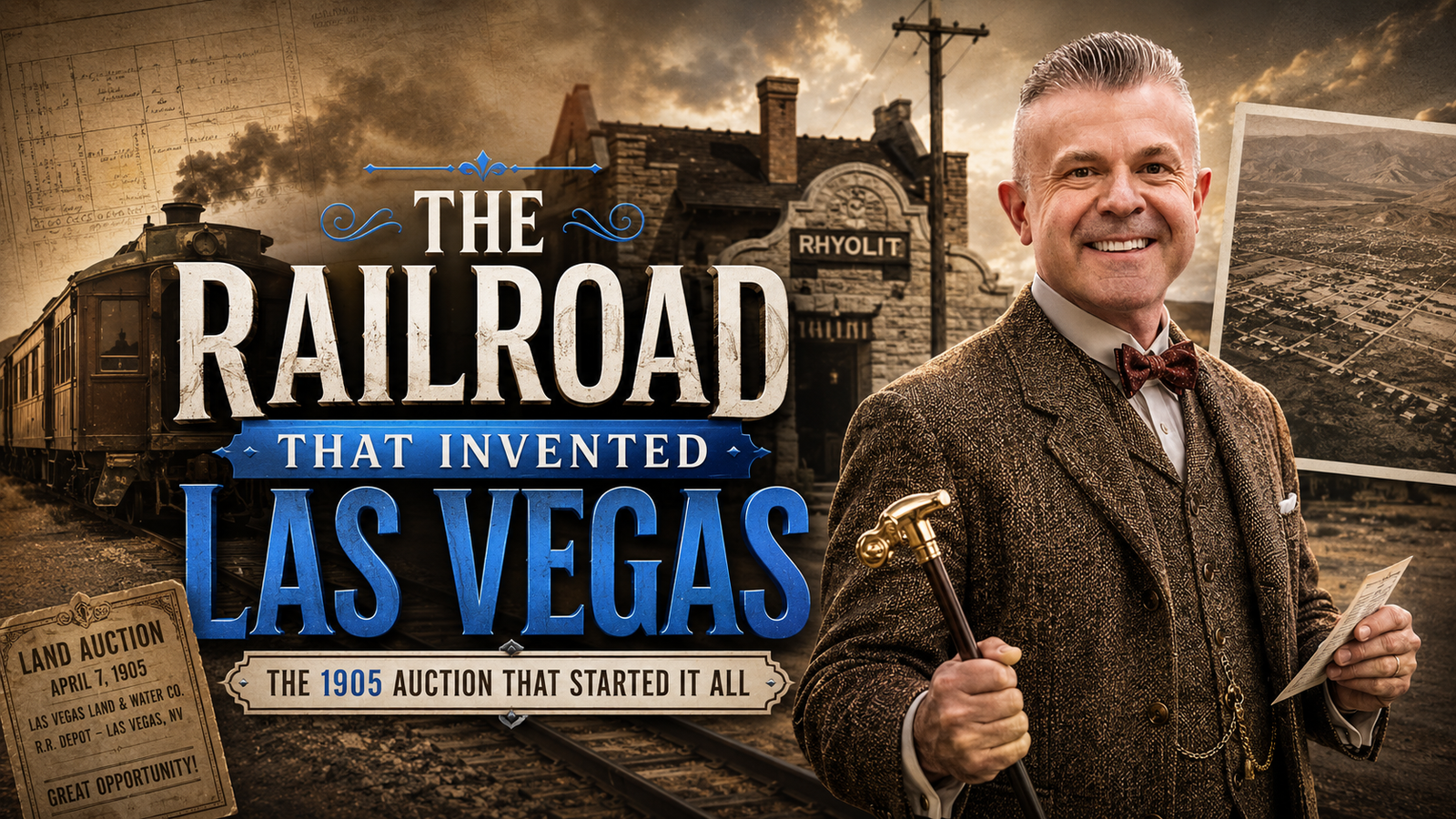
The Railroad That Invented Las Vegas: Inside the 1905 Land Auction That Started It All
On the morning of May 15, 1905, a crowd of roughly 3,000 people gathered in the open desert at a railroad siding called Las Vegas. They had arrived by special excursion train from Los Angeles. There were no streets yet — just stakes in the caliche soil, string lines marking imaginary blocks, and an auctioneer ready to sell the future city of Las Vegas to the highest bidder.
By sundown, the San Pedro, Los Angeles & Salt Lake Railroad and its land subsidiary, the Las Vegas Land and Water Company, had sold over 1,200 lots. The railroad pocketed an estimated $265,000 in a single afternoon — roughly $9 million in today's dollars. The town of Las Vegas did not evolve. It was created at auction, by a railroad company, in about eight hours.
That is the original Las Vegas real estate deal. And almost nobody who lives here knows the full story.
How a Railroad Built a Town to Save Itself Money
The story of the 1905 auction starts with a practical engineering problem, not a grand vision for a city. Senator William Andrews Clark of Montana — copper magnate, railroad baron, occasional U.S. senator — needed a rail route connecting Salt Lake City to Los Angeles. The Nevada desert was the logical path, but the stretch through the Mojave required water: water for the steam locomotives, water for the work crews, water for the maintenance facilities that would have to exist somewhere along the line.
The Las Vegas Valley had artesian springs. It had been a watering stop on the Old Spanish Trail for decades. Clark's railroad surveyors chose it as the site for a major division point — a place where engines would be swapped, cars inspected, crews rested, and equipment repaired. To support all of that, they needed a town. And rather than simply build company housing, they decided to sell the land and let the market do the work.
The Las Vegas Land and Water Company was incorporated as a railroad subsidiary specifically to manage this. It platted a townsite of 40 blocks on land the railroad had acquired, laid out a grid of named streets, and reserved key parcels for the railroad's own use — the depot, the ice plant, the roundhouse. Everything else went up for sale on May 15th.
Records now held in the UNLV Special Collections — part of the San Pedro, Los Angeles & Salt Lake Railroad Company Records (MS-00007) — document what came next: correspondence and contracts relating to lots in the Las Vegas townsite, payments and accounts, invoices and audit materials stretching from 1905 through 1923. They are the paper trail of a city being assembled transaction by transaction.
The Auction Itself: Three Thousand People, String Lines, and a Gavel
The railroad ran two special excursion trains from Los Angeles carrying prospective buyers, speculators, and the simply curious. Bidders were handed maps of the townsite. Auctioneers worked multiple blocks simultaneously. Prices ranged from around $100 for a basic residential lot to several hundred dollars for prime commercial parcels near the depot — the Vegas equivalent of buying on the corner of Main and Fremont before either street existed.
The auction rules mattered as much as the prices. The Las Vegas Land and Water Company imposed deed restrictions requiring buyers to build within a set timeframe. Saloons were restricted to specific blocks — the railroad wanted a functioning town, not a chaotic camp. Water rights, controlled entirely by the railroad's subsidiary, were bundled with the land. You bought a lot; you got access to the company water system. The railroad retained the infrastructure leverage.
Horace Ingersoll Bettis, Vice President and General Auditor of the railroad and the Las Vegas Land and Water Company, oversaw the financial records of the whole enterprise. His name appears throughout the UNLV archive — the man who made sure the receipts matched the stakes in the ground.
Within two years, Las Vegas had a post office, hotels, a school, and a population pushing 1,500. The railroad had created exactly what it needed: a service town for its division point, populated and paid for by the buyers themselves.
Why It Matters Today
The 1905 auction explains things about Las Vegas that still feel true 120 years later. This has always been a city that builds fast, sells aggressively, and believes in the next deal. The original grid — those 40 blocks auctioned off in an afternoon — forms the bones of Downtown Las Vegas today. Fremont Street exists because the railroad's townsite put it there.
More than that, Las Vegas has always been shaped by infrastructure decisions made by entities larger than any individual resident. The railroad picked this valley. The Hoover Dam electrified it. McCarran (now Harry Reid International) connected it to the world. Brightline West is now building high-speed rail to Southern California — an echo of the same Los Angeles-to-Nevada corridor Clark's railroad opened in 1905.
If you own a home anywhere in the valley, you own a descendant of that original auction lot. The chain of title in Clark County traces back, directly or indirectly, to the day a railroad company sold a desert into a city.
Kirby Scofield has spent years studying how this valley was built — and that history shows up in how we think about every neighborhood, every transaction, and every corner of the market today.
Frequently Asked Questions
When exactly was Las Vegas founded, and who founded it?
Las Vegas was formally established as a townsite on May 15, 1905, when the San Pedro, Los Angeles & Salt Lake Railroad and its subsidiary, the Las Vegas Land and Water Company, auctioned off approximately 1,200 lots in a single day. The railroad, controlled by Montana Senator William Andrews Clark, chose the Las Vegas Valley as a division point on its route between Salt Lake City and Los Angeles.
Where can I find historical records from the 1905 Las Vegas land auction?
The primary archive is the San Pedro, Los Angeles & Salt Lake Railroad Company Records (MS-00007), held at the UNLV Special Collections library on the University of Nevada, Las Vegas campus. The collection includes lot contracts, correspondence, payment records, and audit materials from 1905 through 1923 — the actual paper trail of the city's founding real estate transactions.
How does the 1905 railroad townsite relate to Downtown Las Vegas today?
The original 40-block grid platted by the Las Vegas Land and Water Company in 1905 directly corresponds to the core street layout of Downtown Las Vegas today. Fremont Street, the first main commercial corridor, was part of that original plat. The railroad depot was located where the Plaza Hotel now stands at the top of Fremont Street, anchoring the downtown grid that still exists.