
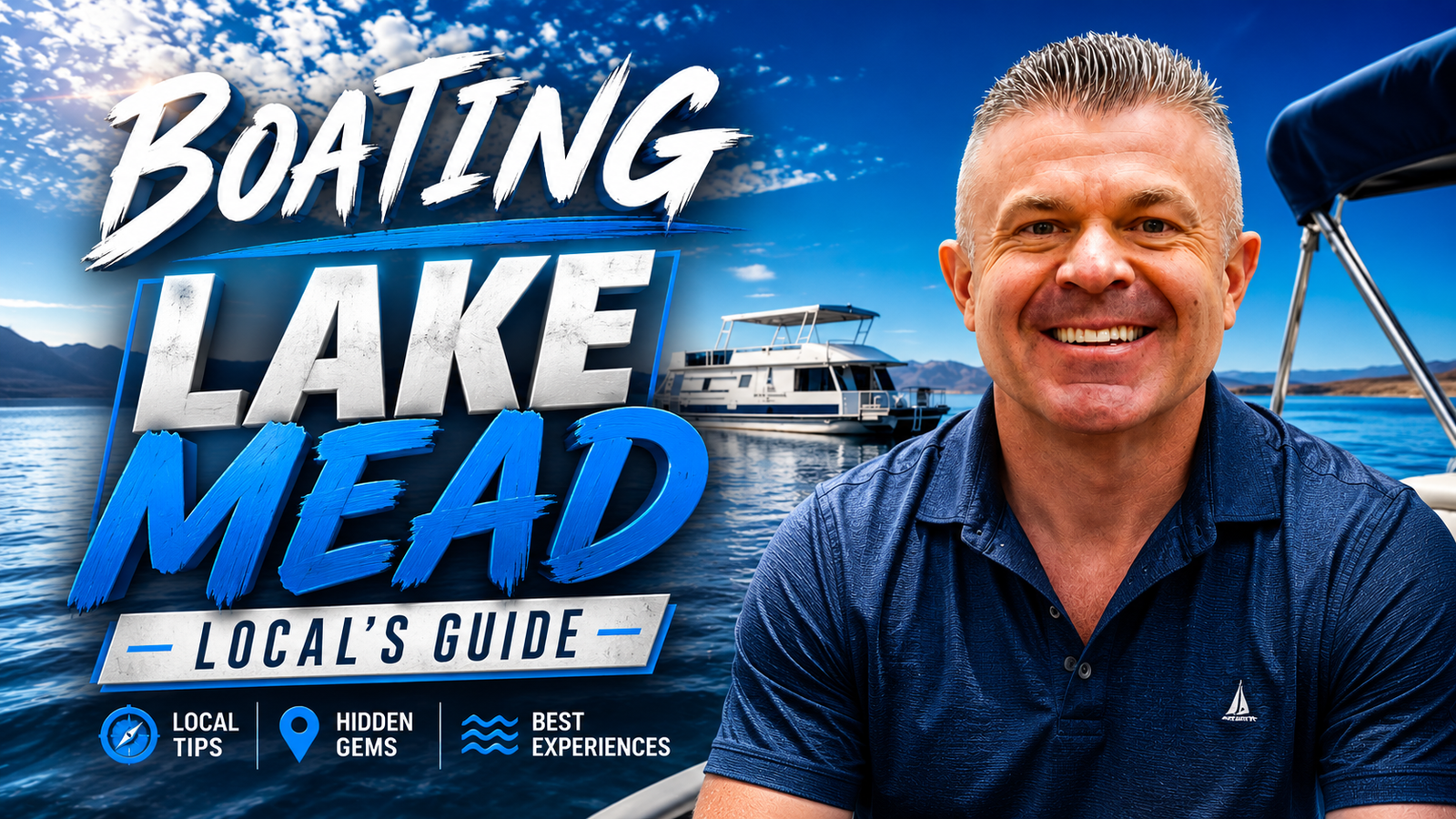
Boating Lake Mead: The Local's Guide to America's Largest Reservoir in Vegas's Backyard
In 1935, the federal government finished plugging the Colorado River with 3.25 million cubic yards of concrete, and what happened next was almost incomprehensible: a desert filled with water. It took seven years for Lake Mead to fill completely — 26.12 million acre-feet of water spread across 247 square miles, making it the largest reservoir by volume in the United States. And it sits roughly 30 miles from the Las Vegas Strip.
Most newcomers to Las Vegas drive right past it on US-93 toward Boulder City without ever launching a boat. That's a mistake worth correcting.
The Dam That Built the Desert — and the Lake That Came With It
Before Hoover Dam was finished, Las Vegas was a railroad stop of about 5,000 people. The construction workforce alone nearly tripled the valley's population overnight, laying the social and economic groundwork for what the city eventually became. The dam was audacious — at the time of its completion, it was the tallest in the world at 726 feet — and it created something nobody on the Colorado River had ever seen before: a permanent, reliable water supply in the Mojave Desert.
The lake is named after Elwood Mead, the Bureau of Reclamation commissioner who oversaw the project. What Mead probably didn't anticipate was that his namesake reservoir would one day become one of the most popular recreational destinations in the American Southwest, drawing roughly 8 million visitors per year.
The other thing nobody anticipated: the ghost town of St. Thomas, Nevada, which was submerged when the lake filled. During the severe drought years of the early 2000s, as water levels dropped dramatically, the ruins of St. Thomas began resurfacing — crumbling adobe walls rising out of the mud flats like something from a fever dream. Water levels have fluctuated significantly since then, and the lake's surface elevation remains a closely watched number throughout the Southwest.
Boating Lake Mead: The Local's Practical Guide
The good news for valley residents: getting on the water is genuinely straightforward. Here's how locals actually do it.
**Marinas and Launch Points**
The two primary marinas on the Nevada side are Las Vegas Boat Harbor and Lake Mead Marina, both operated by Boating Lake Mead. Las Vegas Boat Harbor sits closest to the valley via Boulder Highway — you're looking at roughly 35 minutes from the central valley on a non-peak morning. Lake Mead Marina is a bit farther east but offers protected cove access and slip rentals for those who store their boats on-site. Both marinas have fuel, courtesy docks, and launch ramps.
For Henderson and southern valley residents, the Hemenway Harbor launch ramp near Boulder City is a logical alternative with reliable parking.
**Rentals and Waverunners**
You don't need to own a boat to spend a day on the water. Boating Lake Mead's showroom on Boulder Highway carries new Bayliner sport and deck boats, Yamaha jet boats, Sea Ray cruisers, Boston Whaler fishing boats, and a selection of pre-owned vessels. They also rent Yamaha WaveRunners — the fastest way to get on the water without a trailer or ownership commitment.
**Storage**
For residents who buy a boat and want to avoid the trailering hassle, both marinas offer slip and dry storage options. Given the valley's summer heat, covered storage is worth the premium — UV damage to gel coat and upholstery in a Las Vegas summer is real.
**The Best Coves**
Bowman Wash and Ringbolt Hot Springs (accessible by water on the Arizona side) are local favorites for anchoring and swimming. Calville Bay, on the northern arm of the lake, offers some of the most dramatic red-rock scenery and tends to be less crowded than the main channel on summer weekends. Echo Bay — farther northeast — rewards the boaters willing to make the run with quieter anchorages and striking canyon walls.
Why It Matters Today — Living Near America's Largest Reservoir
For anyone evaluating where to live in the Henderson corridor or eastern Las Vegas valley, Lake Mead isn't just a recreational footnote — it's a defining regional amenity. Summer heat in the valley regularly tops 110°F, and having a 247-square-mile lake 30 minutes away changes the calculus on outdoor living entirely. Residents who boat, kayak, paddleboard, or even just drive out to sit at the shoreline have a genuine heat escape that most desert cities don't offer.
It also matters in a more fundamental way: Lake Mead is the primary water source for roughly 90% of Southern Nevada's municipal supply. The Southern Nevada Water Authority draws from the lake, treats it, and delivers it to valley taps. Water level fluctuations aren't just environmental news — they're infrastructure news for every homeowner in Clark County.
For people relocating from coastal markets, discovering Lake Mead is often the moment the desert stops feeling like a sacrifice. A 36-foot Sea Ray in a marina slip, 30 minutes from downtown, with no state income tax — that's a combination that's hard to find anywhere else in the country.
Frequently Asked Questions
How far is Lake Mead from Las Vegas?
The closest marina, Las Vegas Boat Harbor, is approximately 30–35 miles from the central Las Vegas valley via Boulder Highway (US-93). Under normal traffic conditions, the drive runs about 35–40 minutes from the Strip corridor and roughly 25 minutes from Henderson's eastern neighborhoods.
Do you need a boating license to operate a watercraft on Lake Mead?
Nevada requires anyone born on or after January 1, 1983 to carry proof of completing a Nevada-approved boater education course when operating a motorized vessel. The Nevada Division of Wildlife offers an approved online course. Out-of-state boater education cards from states that meet the NASBLA standard are generally accepted.
Is boating Lake Mead open year-round?
Yes — Lake Mead National Recreation Area is open year-round, and both Las Vegas Boat Harbor and Lake Mead Marina operate through all seasons. Fall and spring offer ideal conditions with mild temperatures and lighter crowds. Summer weekends are the busiest, so early launch times (before 8 a.m.) make a noticeable difference. Winter weekdays are almost uncrowded by comparison.