

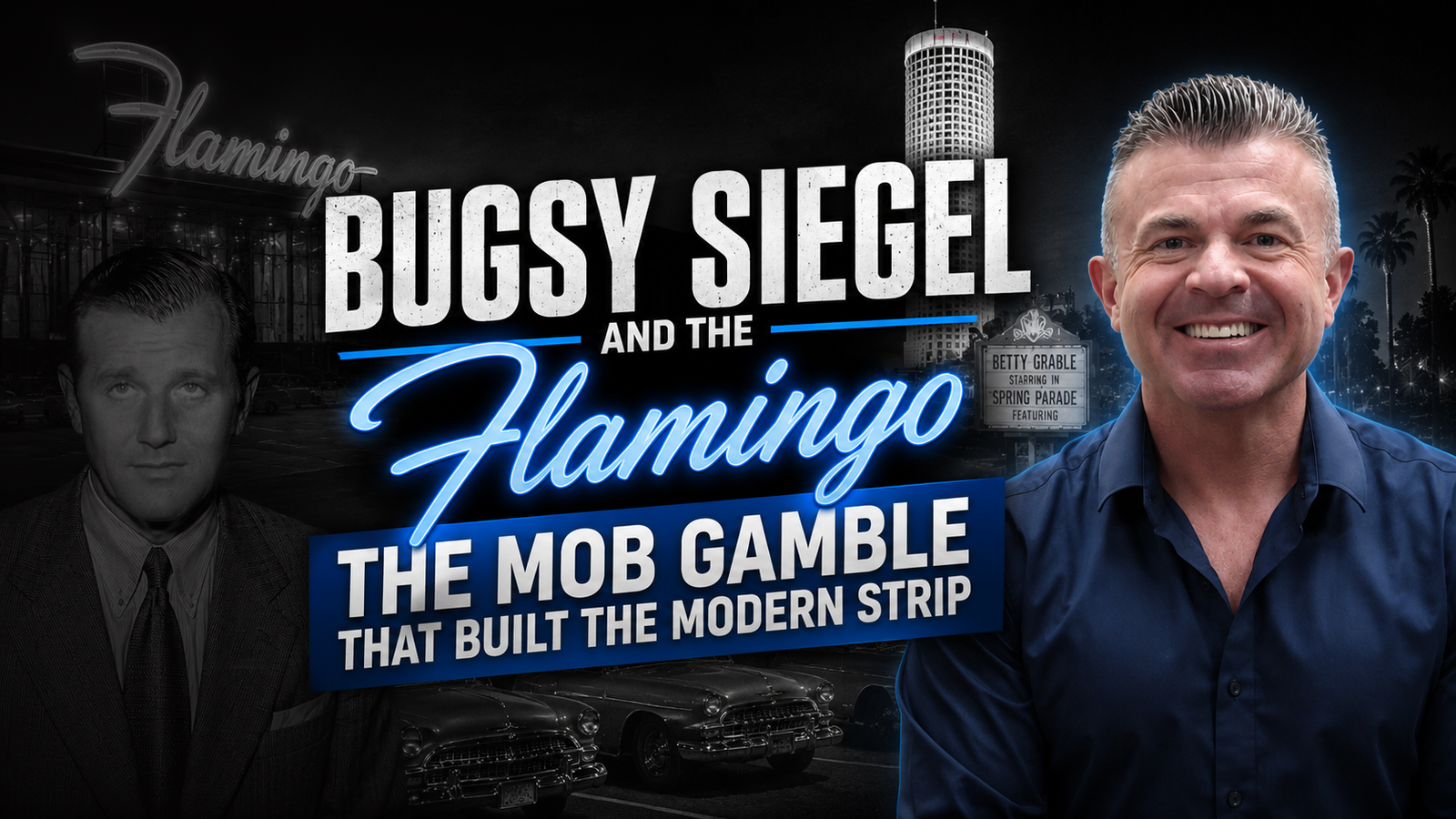
Bugsy Siegel and the Flamingo: The Mob Gamble That Built the Modern Strip
Six million dollars. That was the number that got Bugsy Siegel killed.
On the evening of December 26, 1946, Benjamin Siegel stood inside his half-finished resort on a scrubby stretch of U.S. Highway 91, a few miles south of downtown Las Vegas, and tried to convince the world — and his mob financiers — that the Flamingo was the future. The carpets were in. The chandeliers were lit. The casino floor hummed. The hotel rooms were not ready. Guests had nowhere to sleep. Most of them drove back to downtown Las Vegas that same night. The Flamingo lost money every day it stayed open.
Siegel shut it down after two weeks.
It is almost certainly the most consequential failed opening in American real estate history.
How a Mob Enforcer Ended Up Building a Desert Resort
The story of Bugsy Siegel and the Flamingo doesn't start in Nevada. It starts in Los Angeles, where Siegel had spent the early 1940s running gambling operations and building connections across the entertainment industry. He was charming, violent, and genuinely obsessed with the idea that legitimate resort gambling — the kind you dressed up for, the kind with a real hotel and real restaurants — could be something bigger than the back-room joints everyone else was running.
The plot of land on Highway 91 already had a small club on it called the Flamingo, owned by Billy Wilkerson, the founder of The Hollywood Reporter. Siegel bought in, pushed Wilkerson out, and started construction in 1945. The original budget was around $1.5 million. By the time the doors opened, costs had ballooned to somewhere between $5 million and $6 million — a figure that infuriated the East Coast mob investors, primarily Meyer Lansky's network, who had funded the project.
Construction graft was rampant. Materials ordered for the site were reportedly being resold and then reordered. Whether Siegel knew, looked the other way, or was the one skimming has been debated by historians for decades. What is not debated: the money was gone, the resort was unfinished, and the mob wanted answers.
The Rocky Opening and the Murder That Followed
The Flamingo reopened in March 1947 under tighter management and actually turned a profit within a few months. Siegel seemed to have bought himself time. By June, the resort was doing well enough that he was spending evenings at his girlfriend Virginia Hill's home at 810 Linden Drive in Beverly Hills.
On the night of June 20, 1947, someone fired a .30 caliber military carbine through the living room window. Siegel was hit multiple times. He was 41 years old.
No one was ever charged. No one was ever convicted. The case remains officially unsolved.
Within twenty minutes of the shooting, associates of Meyer Lansky walked into the Flamingo and took control of the property. The timing has never required much explanation.
The murder made international headlines. And paradoxically, the notoriety accelerated exactly what Siegel had predicted: serious money started looking at that stretch of Highway 91 — soon to be known as the Las Vegas Strip — as the place to build.
Why It Matters Today: The Strip as a Blueprint for the Valley
The Flamingo's legacy isn't just a good crime story. It is the template for how Las Vegas grew into one of the most visited cities on earth, and how the resort economy became the engine that drives residential real estate across the entire valley.
The model Siegel insisted on — destination resort, not just a casino; entertainment, not just gambling; architecture that signals arrival — became the DNA of every major property that followed. The Las Vegas Strip corridor that exists today, running from Mandalay Bay to the Sahara, traces directly back to that remote stretch of highway where a mobster decided to build something no one believed in.
For people who live here, that history is more than trivia. The hospitality and gaming economy that the Flamingo helped pioneer employs hundreds of thousands of valley residents. It is the reason the metro grew from roughly 25,000 people in 1950 to nearly 2.3 million today. It is why corporate relocations keep coming, why the sports infrastructure keeps expanding, and why buyers from California — drawn by Nevada's no state income tax and the sheer scale of the valley's job market — keep arriving every month.
The original Flamingo building Siegel opened is long gone, replaced through decades of expansion and renovation. But the name is still there on the Strip, the neon still pink, one of the few casino brands old enough to connect directly to the moment this city became what it is.
Kirby Scofield and the team have spent years helping people find their place in this valley — knowing the history is part of knowing the place.
Frequently Asked Questions
When did Bugsy Siegel open the Flamingo, and how much did it cost?
Benjamin Siegel opened the Flamingo on December 26, 1946, on what is now the Las Vegas Strip. Construction costs ballooned from an original budget of roughly $1.5 million to an estimated $5–6 million, a massive overrun that strained his relationships with mob financiers and is widely cited as a factor in his murder six months later.
What happened to Bugsy Siegel after the Flamingo opened?
Siegel was shot and killed at Virginia Hill's home in Beverly Hills on June 20, 1947, less than a year after the Flamingo's troubled opening. The murder was never officially solved and no one was ever prosecuted, though mob involvement has been the consensus assumption among historians and law enforcement for decades.
Does the original Flamingo building still exist in Las Vegas?
No. The original structure that Siegel opened in 1946 has been entirely replaced through multiple phases of renovation and expansion over the decades. The current Flamingo Las Vegas on the Strip is a large modern resort that preserves the name and branding but shares no original architecture with Siegel's building.