

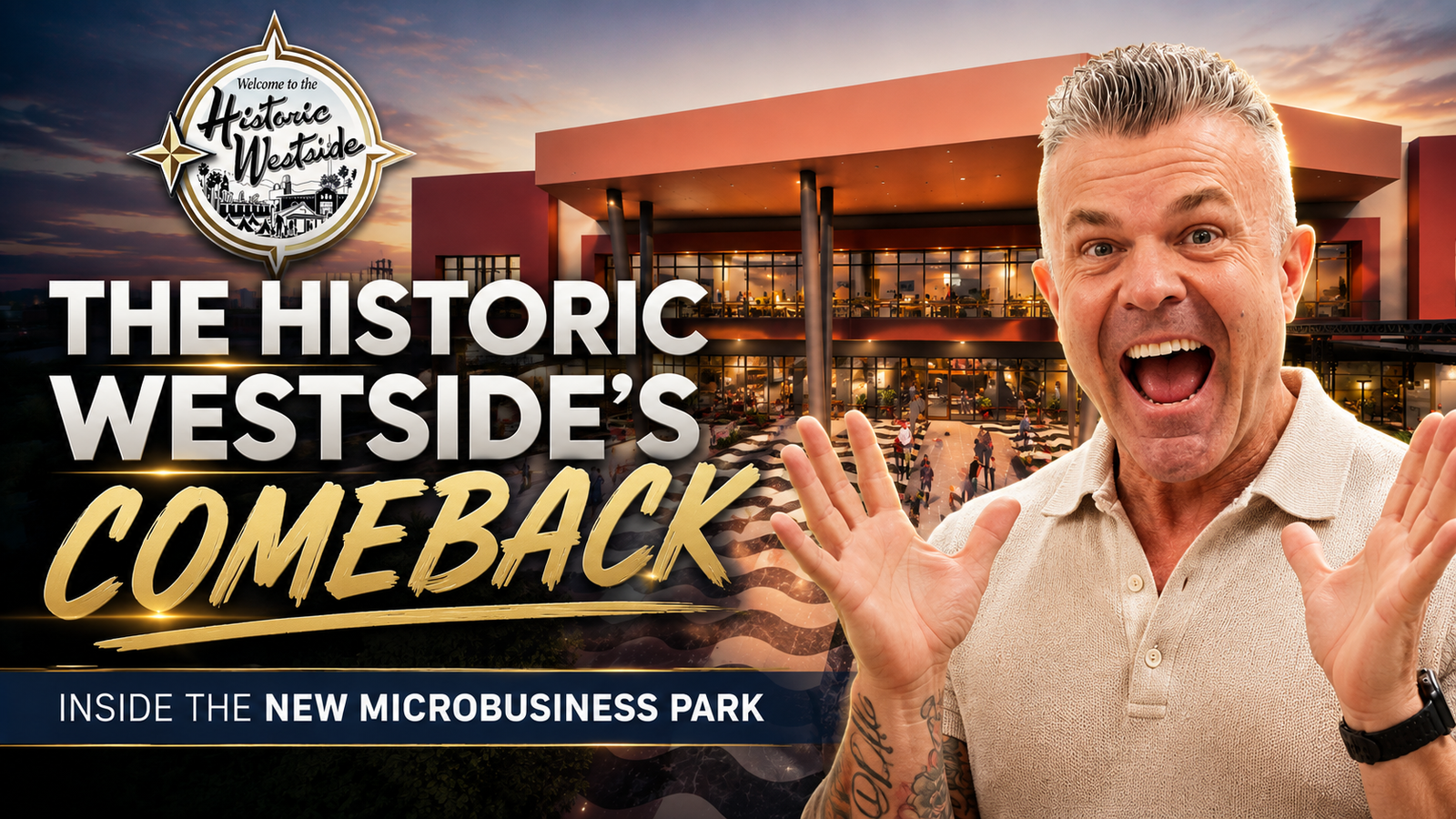
The Historic Westside's Comeback: Inside the New Microbusiness Park
In the spring of 2024, shovels broke ground on a patch of land just west of the Strip that most Las Vegans have driven past without a second thought. What's going up there — a microbusiness park unlike anything Clark County has seen before — is the latest chapter in one of the valley's most overlooked and genuinely remarkable stories.
This is the Historic Westside's comeback. And it's been a long time coming.
The Neighborhood Las Vegas Forgot to Talk About
In the 1940s, when the casino industry was booming and Las Vegas was being built into an entertainment capital, Black residents and workers were systematically excluded from living on the east side of the city's main corridor. The Historic Westside — the blocks north and west of what is now Downtown Las Vegas — became the community they built for themselves.
At its peak, the Westside was a self-contained world. Jackson Street was its commercial spine, lined with businesses, jazz clubs, and restaurants. Performers like Sammy Davis Jr., Nat King Cole, and Louis Armstrong headlined the Strip hotels but were refused rooms there — they stayed and played the clubs on the Westside instead. It was, by accounts of people who lived it, a neighborhood with genuine density of culture and economic life.
Then came urban renewal, highway construction, and the desegregation of the casino industry — each with complicated effects. Integration opened doors on the east side of the city, but it also drained talent, capital, and foot traffic from the Westside. Decades of disinvestment followed. The jazz clubs closed. Businesses shuttered. Population hollowed out.
Today, the Historic Westside covers roughly the area bounded by Washington Avenue to the south, Owens Avenue to the north, Interstate 15 to the east, and Rancho Drive to the west. It sits less than two miles from Fremont Street. By every measurable metric — income, business density, housing stock — it has lagged far behind the rest of the valley.
What the Microbusiness Park Actually Is
Clark County Commissioner William McCurdy II, whose district includes the Westside, has described the new microbusiness park as something that has never been seen before in Clark County. That's not hyperbole for the cameras — the project is genuinely novel in its structure and its intent.
Funded through pandemic-era federal relief dollars, the microbusiness park is being built on land strategically positioned next to two existing anchors: the Las Vegas Culinary Academy and Nevada Partners, a workforce development nonprofit that has operated in the Westside for decades. The placement is deliberate. The idea is an ecosystem — train workers, then give them a place to launch and operate small businesses within walking distance of where they trained.
The project is slated to open in 2026. When it does, it will offer small-footprint commercial spaces — the kind that are accessible to entrepreneurs who can't afford the lease rates demanded in the Arts District or near the Strip. Think food entrepreneurs, skilled tradespeople, service businesses, and tech-adjacent small operators who need affordable commercial space with built-in support infrastructure nearby.
Commentary from the groundbreaking was pointed: until more industries take root in the Westside and upskilling within the workforce expands, the path to a high quality of life for residents there remains narrow. The microbusiness park is positioned as a structural answer to that problem — not a one-time grant, but a lasting commercial asset in the neighborhood.
The project also has a homelessness-reduction dimension. The Westside has among the highest rates of housing instability in the valley, and economic development — stable employment, small business ownership, living-wage jobs — is increasingly understood as upstream prevention for homelessness rather than a separate policy lane.
The Historic Westside's Comeback: Why It Matters Right Now
For Downtown Las Vegas and the broader city, a revitalized Westside would close one of the most glaring geographic gaps in the valley's growth story. The rest of Las Vegas has seen sustained investment — Summerlin master-planned communities to the west, Henderson's Cadence and Inspirada corridors to the southeast, stadium and arena development along the Strip. The Westside has largely watched from the margins.
For investors and buyers paying attention to where the valley is heading, proximity to genuine infrastructure investment — workforce training pipelines, new commercial anchors, county-backed development — is worth tracking. Neighborhoods with that combination don't stay undervalued indefinitely. That's not a pitch; it's pattern recognition from watching Las Vegas develop for decades.
For residents who simply care about this city as a place to live, the Westside story is worth knowing. It's part of what Las Vegas actually is — not just the lights and the resorts, but the people and communities that made the whole thing run.
Kirby Scofield and the team at The Scofield Group have watched this part of the valley closely for years. If you're curious about what's developing here and what it means for the surrounding neighborhoods, they're an honest source.
---
Frequently Asked Questions
Where exactly is the Historic Westside in Las Vegas?
The Historic Westside is a neighborhood in central Las Vegas generally bounded by Washington Avenue to the south, Owens Avenue to the north, Interstate 15 to the east, and Rancho Drive to the west. It sits approximately 1.5 to 2 miles northwest of the Fremont Street Experience in Downtown Las Vegas.
When will the new microbusiness park open, and who is it for?
The microbusiness park is projected to open in 2026. It is designed to provide affordable small-footprint commercial space for entrepreneurs and small business owners in and around the Historic Westside, situated next to the Las Vegas Culinary Academy and Nevada Partners to support workforce training and business launch in the same corridor.
How was the microbusiness park funded?
The project was funded through federal pandemic-era relief dollars administered at the county level. Clark County Commissioner William McCurdy II has been a primary advocate for the project, describing it as a first-of-its-kind development for Clark County in terms of its scale and approach to community economic development.