

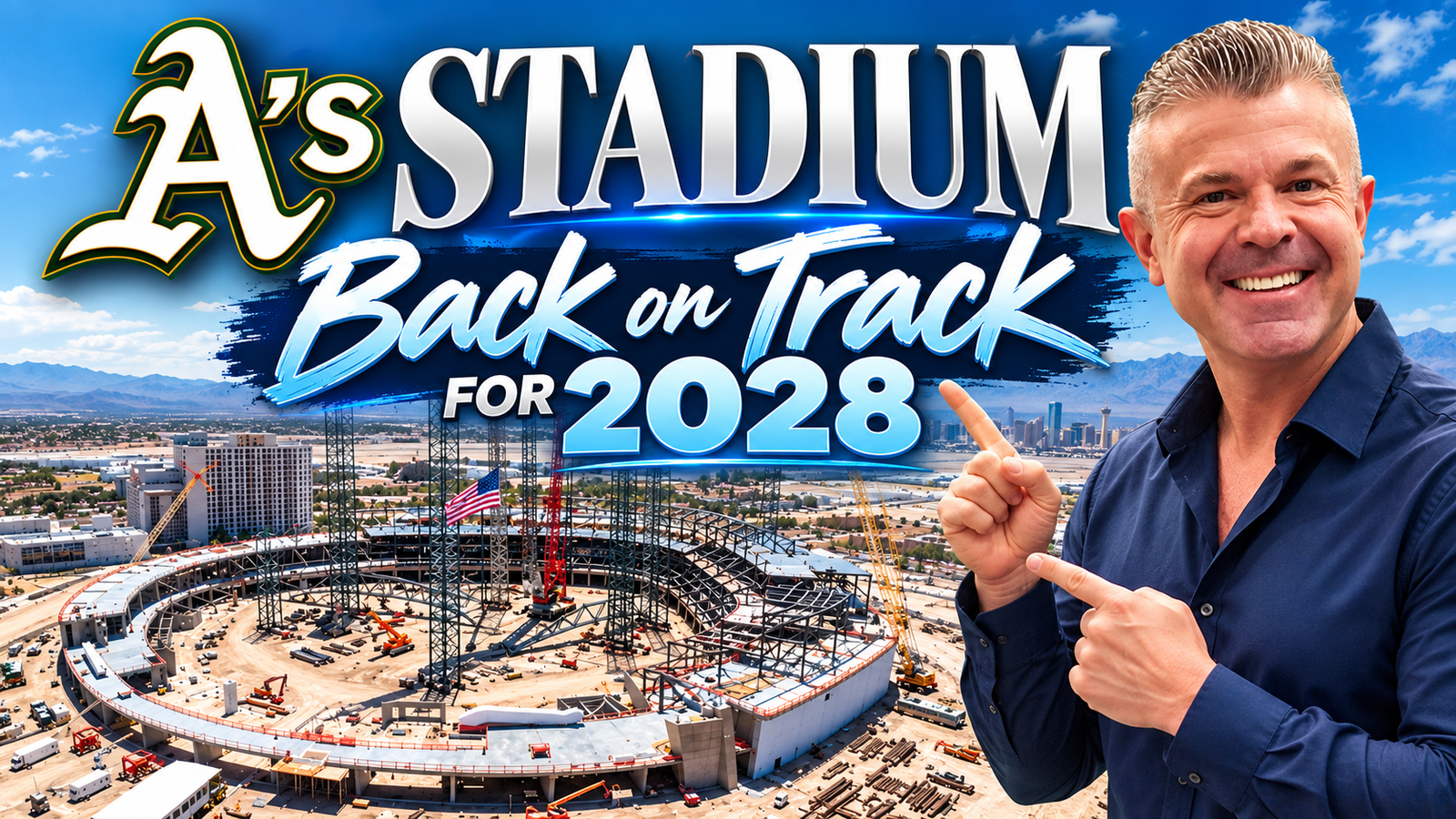
The A's Stadium Is Back on Track for 2028 — What That Means for Las Vegas Property Values Nearby
The Athletics' Las Vegas ballpark is no longer a plan on paper. Crews broke ground in June 2025, the foundation was finished in early 2026, and the steel seating bowl went up this spring. The team says the $2 billion, 33,000-seat stadium is on schedule and on budget for an opening before the 2028 season. For anyone watching Las Vegas A's stadium real estate, the question is no longer whether the stadium will get built. It's what will surround it, and how much that will matter to nearby neighborhoods.
What the Latest Plans Actually Show
The ballpark takes up about 9 acres of the 35-acre former Tropicana site at Las Vegas Boulevard and Tropicana Avenue. The Tropicana was demolished in October 2024. Bally's Corp. holds the development rights to the remaining 26 acres.
In August 2026, the Clark County Commission approved part of a revised, three-phase plan for the site. The approved pieces are an elevated podium on the northwest corner, which will serve as the main pedestrian entrance to the ballpark (the stadium sits nearly 40 feet above street level), plus a 2,500-seat theater and structured parking. The A's have taken over construction of a 1,500-space parking garage and a central utility plant on the southeast corner, work that Bally's was originally expected to handle.
The rest of the district is less certain. Bally's proposed hotel-casino towers still need FAA approval and were held for a later county review. Bally's has also been under financial pressure, and published reports say another casino operator has shown interest in buying its rights to the project. County officials have noted that the land-use approvals stay with the land, so another developer could build under them if Bally's steps away.
Why this matters: the ballpark itself is close to a sure thing, but the size and timing of the retail, dining, and hotel development around it are still in play. That surrounding development is what would drive most of the economic ripple effects.
How Stadium Projects Actually Affect Property Values
The research here is more mixed than stadium boosters usually admit. Some studies find modest property value gains close to new venues, especially where the project sparks new restaurants, retail, and housing. Others find little measurable effect, or declines for homes hit by game-day traffic, noise, and parking pressure. Most economists who study sports venues are skeptical of large neighborhood-wide gains.
Las Vegas is also an unusual case. Most stadium studies look at venues built to revive underused districts. This ballpark sits in the middle of an existing resort corridor, and the plan leans on nearby MGM Resorts properties for game-day parking. A good share of the spending fans do on game days may stay inside casino properties rather than flowing into surrounding neighborhoods. Allegiant Stadium, a few miles south, is a useful local comparison to study before assuming any particular outcome.
What This Means For You
• Homeowners within a couple of miles of the site may want a current market valuation, mainly so you have a baseline for tracking any stadium effect over the next few years. Find out what your home is worth →
• Investors should focus on the specifics: which blocks will see game-day traffic, where pedestrian routes to the ballpark will run, and whether commercial projects nearby are actually funded and permitted, not just proposed.
• Buyers shouldn't feel rushed by the opening date. Construction is already well underway, so much of the "early" story is public information and may already be reflected in prices. Real changes in demand are more likely to show up after the ballpark opens and fans settle into patterns.
• Expect construction traffic around Tropicana Avenue and Las Vegas Boulevard through at least 2027, plus ongoing event-day congestion once games start.
The A's ballpark will reshape a key stretch of the Strip, but it's not a guaranteed windfall for every nearby property. Owners and buyers who follow the surrounding development, and not just the stadium, will be in the best position to judge what it means for them. You can browse more neighborhood-level analysis on the blog.
Frequently Asked Questions
Which Las Vegas neighborhoods are closest to the A's stadium site?
The ballpark is on the former Tropicana site at the southeast corner of Las Vegas Boulevard and Tropicana Avenue, in the 89109 zip code. Residential areas within about two miles include neighborhoods west of I-15 in 89103 and 89118, and areas east of the Strip in 89119 near UNLV.
Will the A's stadium raise home prices nearby?
It might, but the evidence from other stadiums is mixed. Gains are most likely where a venue brings real new commercial activity nearby. Homes on heavy traffic or parking routes can see drawbacks. Because this ballpark is inside an established resort corridor, its effect on residential areas may be smaller than in cities where a stadium anchored new neighborhood development.
Is now a good time to buy near the A's stadium site in Las Vegas?
That depends on your finances, how long you plan to stay, and the specific property more than on the stadium schedule. Construction progress is widely reported, so buying now isn't getting ahead of public information. If the stadium is part of your reasoning, focus on how the surrounding development plays out, and talk with a local agent and a financial professional about your situation.
Source: thenevadaindependent.com
Related reading
• Boring Company's $23 Billion Valuation and What It Means for the Vegas Loop's Future
• Downtown Las Vegas Is Adding 390+ Residential Units — Here's What's Coming to Symphony Park