
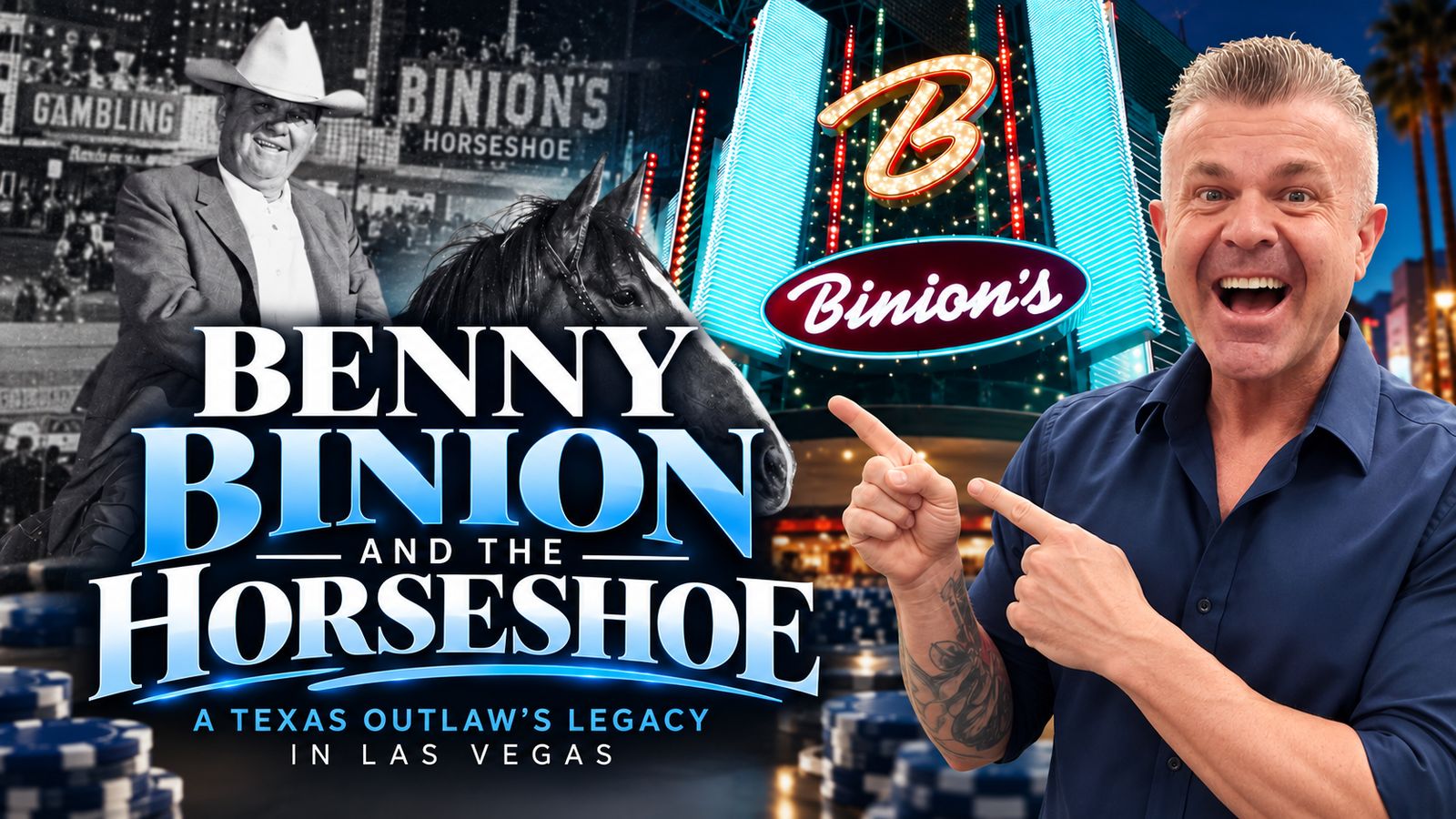
Benny Binion and the Horseshoe: How One Texas Outlaw Shaped Downtown Las Vegas
In 1951, a man with two felony convictions, a history of running illegal numbers operations in Dallas, and at least two killings on his record walked into 128 Fremont Street and bought a casino. His name was Lester Ben Binion, and the place he built there would define downtown Las Vegas for the next half century.
The story of Benny Binion and the Horseshoe: How One Texas Outlaw Shaped Downtown Las Vegas is not a story about rehabilitation. Benny never apologized for who he was. It is a story about a man who understood gamblers better than almost anyone alive, who gave them better odds than they could find anywhere else, and who turned a single block on Fremont Street into the spiritual center of American poker culture.
From Dallas to Fremont Street
Benny Binion grew up hard in Pilot Grove, in North Texas just above Dallas — not, as often repeated, the Texas Panhandle. By his early twenties he was running illegal craps games and numbers operations in Dallas, paying off police, and eliminating competition in ways that went well beyond the legal system. He was tied to at least two killings, and the record on them is mixed: he was convicted in 1931 in the death of bootlegger Frank Bolding and received a suspended sentence, while a second killing, of rival numbers operator Ben Frieden in 1936, was ruled self-defense and never went to trial.
What actually pushed him out of Dallas was politics, not a courtroom. When his law-enforcement protection lost a county election in 1946 and the incoming sheriff backed his rival, Herbert Noble, instead, Binion found himself on the losing end of a gang war. Late in 1946, he packed his family, his cash, and his operation into a car and headed for Nevada, where gambling was legal and the climate suited him fine. The federal tax case people often connect to that exit actually came years later: prosecutors charged him with income tax evasion in the early 1950s, he pleaded guilty in 1953 — two years after the Horseshoe was already open — and he served time at Leavenworth before returning to Las Vegas in 1957.
When he opened the Horseshoe Club in 1951, the place was immediately different from everything else on Fremont Street. Benny put carpet on the floor, which sounds minor until you remember that most casino floors at the time were bare concrete or linoleum. He installed air conditioning. He arranged rides to and from the airport for his players. He treated high rollers like royalty and low rollers like they were welcome anyway. The Horseshoe was not trying to be fancy. It was trying to be fair.
He also raised the betting limits. At the Horseshoe, your first bet set the limit for your session. If you walked in and put $10,000 on the table, that was your limit. No casino in town was doing anything like it. That policy drew serious gamblers from everywhere.
The World Series of Poker and No-Limit Hold'em
In 1970, Benny invited seven of the best poker players in the country to the Horseshoe for a private game. The players voted on who had played best, and Johnny Moss won. That was the first World Series of Poker. The next year Benny changed the format to a freeze-out no-limit Texas Hold'em tournament, and the game that would eventually become a global phenomenon was born on Fremont Street.
For the first decade or so, the World Series of Poker drew dozens of players. By the 1980s it drew hundreds. Benny had created the most important poker event in the world out of a dinner party with his friends.
He also pioneered what we now think of as standard Las Vegas hospitality. Good food at low prices. Generous comps. The idea that the casino should work to keep the player comfortable, not just extract money as fast as possible. Other casinos on the Strip eventually borrowed those ideas, but Benny got there first on Fremont Street.
The Horseshoe After Benny
Benny Binion died in December 1989 at age 85. His children took over the property, and the family held it until 2004 when financial and legal troubles forced a sale. Harrah's Entertainment bought the Horseshoe brand and the downtown property changed hands. Today the building operates as Binion's Gambling Hall, still at 128 Fremont Street, still carrying his name.
The Hotel Apache, one of the oldest hotel structures in Las Vegas, sits inside the building and has been restored. The neon on Fremont Street still draws people past the spot where Benny set up shop more than 70 years ago.
Why It Still Matters Today
Downtown Las Vegas is in the middle of a long, complicated comeback. The Fremont Street Experience, new bars and restaurants, residential projects, and renewed interest in historic preservation are all part of the picture. When you walk past Binion's on Fremont Street today, you are walking past the place where no-limit poker was legitimized, where the World Series of Poker was born, and where a Texas outlaw decided that treating gamblers with respect was good for business.
For anyone living in Las Vegas or thinking about planting roots here, understanding what Fremont Street was built on matters. The city did not grow into what it is by following conventional rules. Benny Binion, more than almost anyone, proved that.
If you want to explore more of what makes this valley worth knowing, browse the Scofield Group blog for local history, neighborhood guides, and real estate insight from people who actually live here.
Frequently Asked Questions
What did Benny Binion do before opening the Horseshoe in Las Vegas?
Benny Binion ran illegal gambling operations in Dallas, Texas throughout the 1930s and 1940s. He relocated to Las Vegas in late 1946 after losing his political protection back home and finding himself on the losing end of a violent turf war with a rival operator. His federal conviction for income tax evasion came later, in 1953, after the Horseshoe was already open.
Did Benny Binion really invent the World Series of Poker?
Benny Binion organized the first gathering that became the World Series of Poker in 1970 at the Horseshoe Club on Fremont Street. It began as an invitational game with a handful of top players and grew into a formal tournament structure the following year. The WSOP now draws thousands of players annually and is considered the most prestigious poker event in the world.
Is Binion's Horseshoe still open in downtown Las Vegas?
The property at 128 Fremont Street still operates as Binion's Gambling Hall. It is no longer affiliated with the Binion family, who sold the property in 2004. The historic Hotel Apache, located inside the building, has been renovated and is open to guests. The casino floor and restaurant remain in operation.
Related reading
• The Neon Museum: How Las Vegas Saves Its Own Story, One Sign at a Time
• The Forever 1 Memorial: How Las Vegas Is Building a Permanent Tribute to October 1
• The Story Behind Sun City Anthem: How Del Webb Built Henderson's Largest 55+ Community