
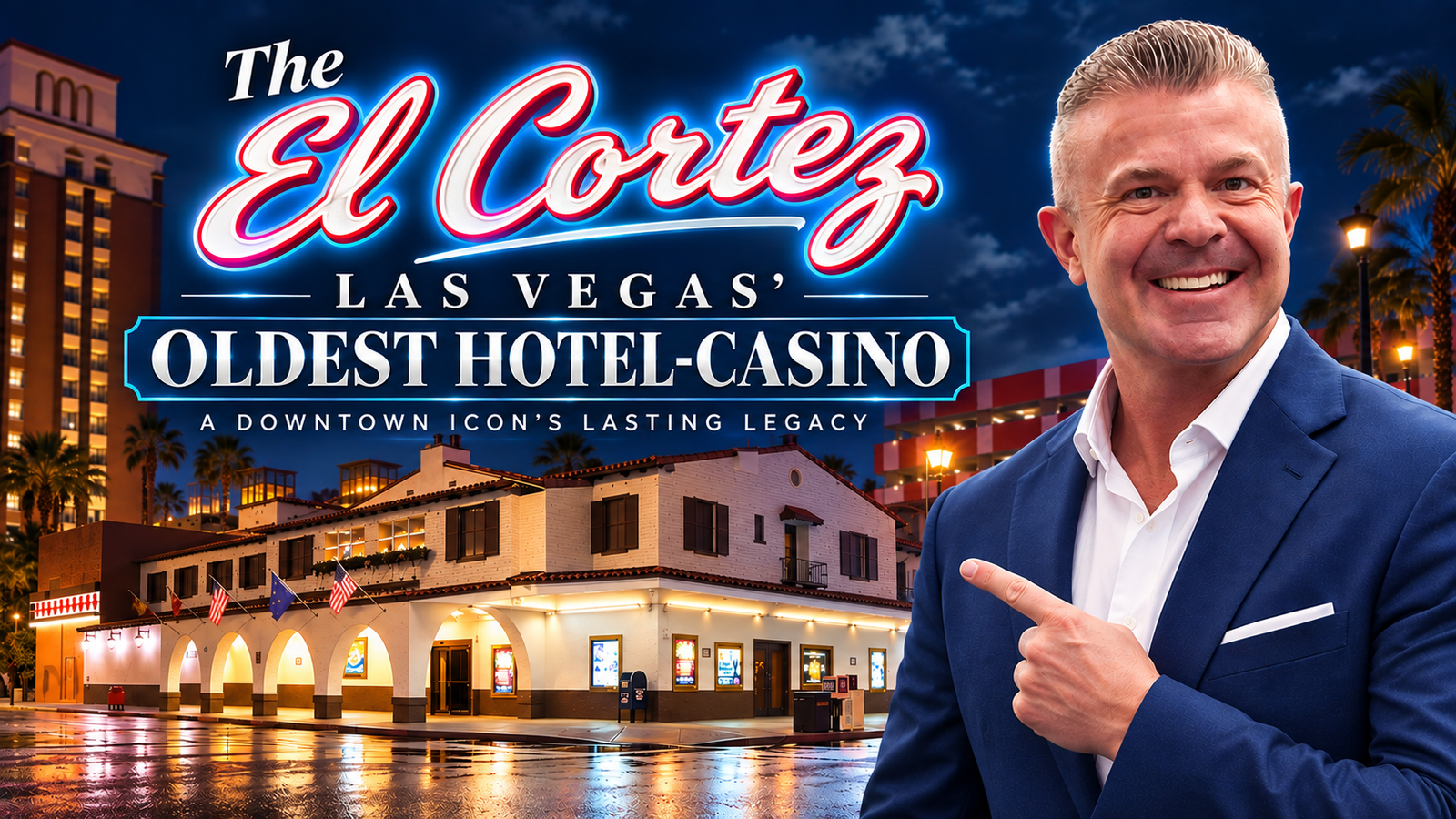
The El Cortez: How the Oldest Hotel-Casino in Las Vegas Shaped Downtown's Story
The El Cortez opened on November 7, 1941, at 600 Fremont Street, about six weeks before Pearl Harbor. It was built by California developers Marion Hicks and John C. Grayson, with local entrepreneur J. Kell Houssels as an early partner in the venture — not, as sometimes told, a Houssels solo production. At a time when Fremont Street was still a dirt-edged strip of neon and ambition, it was Las Vegas's first major hotel-casino resort, and it was an immediate success. Within a few years it was pulling in enough money to attract the attention of people who made a business of noticing profitable things.
In 1945, the property was sold for a reported $600,000 to $800,000 (accounts differ) to a group tied to organized crime — Moe Sedway and Gus Greenbaum were the buyers of record, along with Edward Berman. Bugsy Siegel and Meyer Lansky are widely believed by historians to have been silent partners profiting behind the scenes, though their names didn't appear on the paperwork. The arrangement lasted roughly a year before J. Kell Houssels bought back in, this time with a new partner, Ray Salmon, in 1946. Siegel moved on to the Flamingo project on what was then a mostly empty stretch of Highway 91. We all know how that ended.
The Houssels family ran the El Cortez for decades after that, until Jackie Gaughan bought the property in 1963. It stayed a working casino through the postwar boom, through the era when the Strip started pulling tourists away from downtown, and through every cycle of renewal and neglect that Fremont Street went through in the second half of the twentieth century.
Fremont Street in Its Prime and the Long Slide
For most of the 1950s and 1960s, Fremont Street was the center of Las Vegas gambling. The neon was dense, the crowds were real, and casinos like the Horseshoe, the Golden Nugget, and the Four Queens operated at full capacity.
Across the street from the El Cortez, a J.C. Penney store operated at 520 Fremont Street in the 1950s, part of a stretch of Fremont Street that functioned as a genuine commercial center for the whole valley, not just a gambling corridor — department stores, a Woolworth's, and everyday retail alongside the casinos. (Specific claims about it being the city's largest department store or its first building with an elevator show up in some local history accounts but couldn't be independently confirmed here, so treat those particular details as unverified.)
Then the Strip grew up. Megaresorts with thousands of rooms and controlled entertainment environments pulled convention business and leisure travelers away from downtown through the 1970s and 1980s. Department stores closed. Foot traffic thinned. Fremont Street went through a rough stretch that locals who lived here remember clearly.
The El Cortez kept going through all of it.
What Survival Actually Means
The Fremont Street Experience opened in December 1995, its barrel-vault canopy covering four blocks with a light show, in a public-private effort to pull visitors back downtown. It worked well enough to stabilize the area. Then, over the past decade or so, the Arts District started drawing a different kind of attention. Downtown Container Park opened in late 2013. Independent restaurants, galleries, and bars filled in around it. Developers started looking at downtown Las Vegas as a place to build, not just a place that had already been built.
The El Cortez sits right at the edge of all that activity. It has operated continuously since 1941, which makes it the longest-running hotel-casino in Las Vegas by a wide margin. The building itself was added to the National Register of Historic Places in 2013 — the only operating casino in the country with that distinction — recognizing its Spanish Colonial Revival architecture and cultural significance.
For people thinking about downtown real estate, that history matters practically. The El Cortez is an anchor. Anchors create stability. Neighborhoods built around institutions that have survived eighty-plus years of economic cycles carry a different kind of foundation than neighborhoods built around whatever opened three years ago.
The blocks around Fremont Street East have attracted condo projects, renovated older buildings, and new businesses precisely because the area has an identity. The El Cortez is a big part of where that identity comes from. It is not a museum piece. It runs a hotel, a casino, and a bar. It employs people. It draws visitors who specifically seek out something that feels like Las Vegas before the megaresorts arrived.
Understanding the El Cortez's history is not just trivia. It is context for why downtown looks the way it looks and why investors and buyers are paying closer attention to that part of the valley than they were fifteen years ago. The oldest things on a street often tell you the most about where that street is going.
For more on what is happening across the valley, browse the Scofield Group blog.
Frequently Asked Questions
When did the El Cortez open and who built it?
The El Cortez opened on November 7, 1941, developed by Marion Hicks and John C. Grayson with J. Kell Houssels as an early partner. It was built as a combined hotel and casino on Fremont Street in downtown Las Vegas and quickly became one of the most profitable gambling operations in the city.
What was Bugsy Siegel's connection to the El Cortez?
In 1945, the El Cortez was sold to a group associated with organized crime, for a price reported at anywhere from $600,000 to $800,000 depending on the source. Moe Sedway, Gus Greenbaum, and Edward Berman were the buyers on record; Bugsy Siegel and Meyer Lansky are widely believed to have had a hidden stake in the deal, though this was never documented at the time. The group's involvement lasted roughly a year before J. Kell Houssels bought back in during 1946. Siegel then shifted his focus to the Flamingo project on the Strip.
Is the El Cortez still operating today?
Yes. The El Cortez has operated continuously since 1941, making it the longest-running hotel-casino in Las Vegas. It remains open as a functioning hotel, casino, and bar, and the property has been listed on the National Register of Historic Places since 2013 in recognition of its historical and architectural significance.
Related reading
• The Neon Museum: How Las Vegas Saves Its Own Story, One Sign at a Time
• The Forever 1 Memorial: How Las Vegas Is Building a Permanent Tribute to October 1
• The Story Behind Sun City Anthem: How Del Webb Built Henderson's Largest 55+ Community