
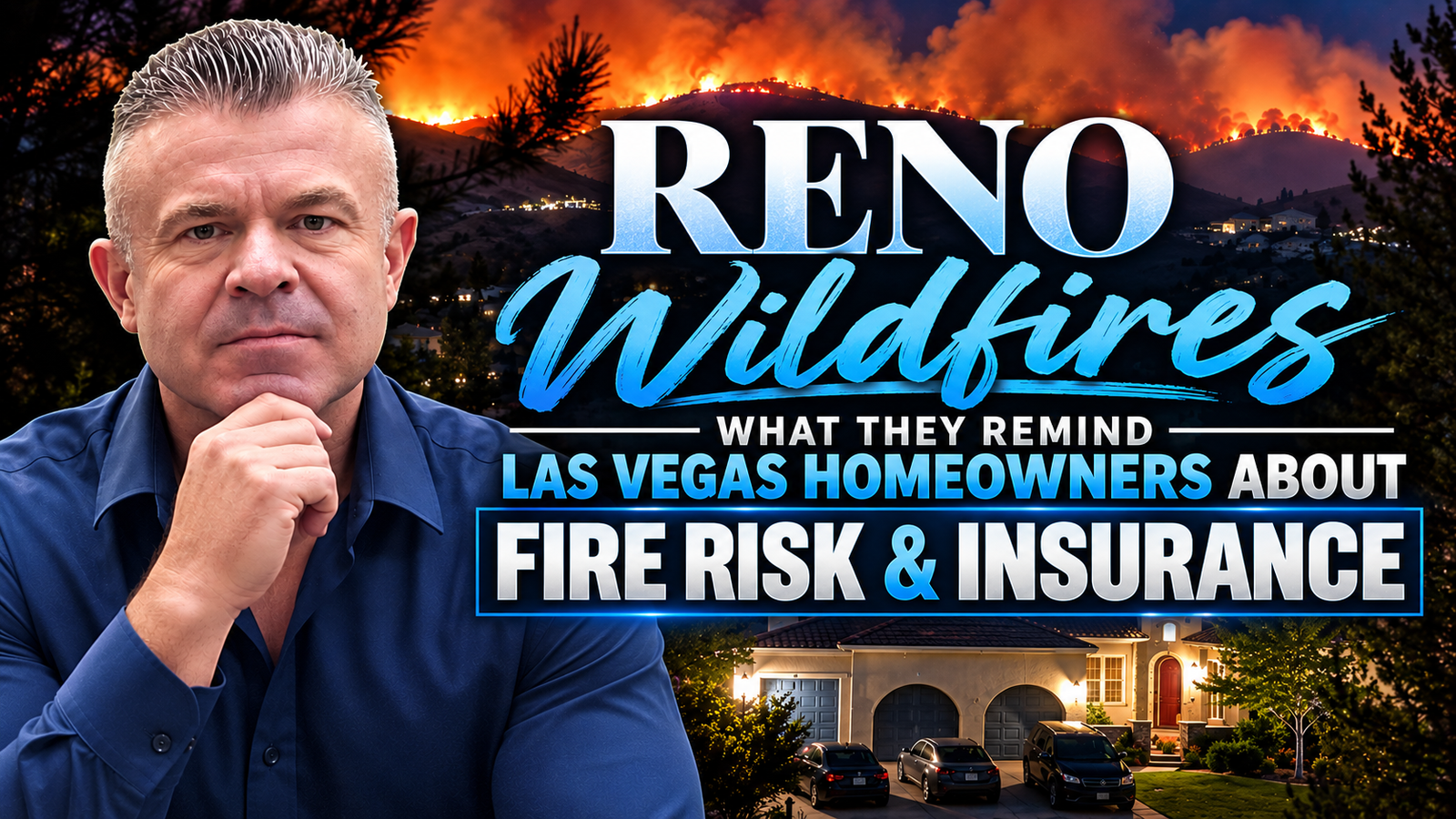
The Reno Wildfires and What They Remind Las Vegas Homeowners About Fire Risk and Insurance
If you own a home in Las Vegas and watched the Hawk Fire force tens of thousands of Reno-area residents out of their neighborhoods in late August, take that unease seriously. Nevada wildfire homeowners insurance is a coverage gap that far too many Southern Nevada homeowners have not looked at closely enough.
What the Reno Hawk Fire Tells Us About Statewide Risk
On August 22, 2026, the Hawk Fire ignited near Peavine Peak northwest of Reno, Nevada's third-most-populous city, and pushed evacuation orders across a wide swath of the region. CBS News reported that tens of thousands of residents were placed under evacuation or warning orders — roughly 42,000 in "go now" zones and another 45,000 in "get set" zones — before the fire was fully contained a week later. Northern Nevada and Southern Nevada face different terrain, but the insurance market does not draw that line cleanly. When wildfires drive major losses anywhere in Nevada, insurers re-price risk statewide, tighten underwriting standards, or exit markets entirely. That is already happening in California, and Nevada homeowners are starting to feel the same pressure.
This isn't just a market trend — it's now written into state law. Assembly Bill 376, which took effect January 1, 2026, allows Nevada insurers to carve wildfire coverage out of standard homeowner policies entirely and sell it separately, or not offer it at all. Regulators frame this as a way to keep some coverage in place rather than losing a policy outright; consumer advocates have criticized it as a step away from the comprehensive protection homeowners insurance is supposed to provide. Either way, it means a wildfire exclusion is no longer just something an insurer might quietly slip in — it's now an explicitly sanctioned option, and Southern Nevada homeowners should expect to see it more often.
If you own property in the Summerlin foothills, the Henderson highlands near the McCullough Range, or anywhere backing up to open desert terrain, your property sits in a zone that fire risk models flag. Nevada's insurance regulators have already noted rising non-renewals in Henderson, Pahrump, and even parts of Las Vegas within city limits. The Clark County Fire Department and the Nevada Division of Forestry both publish resources on defensible space requirements for exactly this reason.
What Las Vegas Homeowners Should Check Right Now
Pull out your current homeowners policy and look at three things.
First, check your dwelling coverage limit. Construction costs in the Las Vegas valley have climbed sharply over the past four years. If your policy was written in 2020 or 2021, the replacement cost figure is almost certainly too low to rebuild at today's material and labor prices.
Second, look for a wildfire or brush fire exclusion. With AB376 now in effect, insurers have explicit legal room to add one, and some have done so at renewal. If yours did, you may not know unless you read the declarations page.
Third, ask your insurer whether they offer extended replacement cost coverage. Standard replacement cost has a ceiling. Extended replacement cost pays above that ceiling, commonly 10 to 50 percent more depending on the carrier, which matters when an entire neighborhood burns and contractor demand spikes.
For Nevada wildfire homeowners insurance guidance, the Nevada Division of Insurance is the right place to check your insurer's licensing status, confirm your rights under Nevada's policy-notice law (NRS 687B.420), and file a complaint if you believe a coverage change was not disclosed properly.
What This Means For You
If your home sits near open desert, a ridgeline, or a wash, treat wildfire coverage as a primary concern, not a footnote.
Ask your insurance agent specifically whether your current policy covers wildfire damage, and get the answer in writing.
Nevada does not currently operate a FAIR Plan or other state-backed insurer of last resort, unlike some other wildfire-exposed states — a bill to create one stalled in the legislature. If your insurer has non-renewed your policy or raised your premium sharply, your best options are an independent broker who works with surplus-lines and specialty wildfire carriers, or one of the standalone wildfire-only policies AB376 now permits insurers to offer.
Homeowners with significant equity should also think about what a major loss event does to their property value and overall financial position. Find out what your home is worth →
The Reno evacuation is a vivid reminder that wildfire can reach urban areas fast. Southern Nevada homeowners do not need to panic, but they do need to know what their policy actually covers before fire season peaks.
Frequently Asked Questions
Does Las Vegas have wildfire risk for homeowners insurance purposes?
Yes. Properties in foothill communities near open desert terrain, including parts of Summerlin, Henderson, and North Las Vegas, carry measurable wildfire exposure that insurers assess when writing or renewing policies. The risk is lower than parts of Northern Nevada but it is real enough that some carriers apply surcharges or exclusions in Clark County — regulators have specifically flagged confusion over non-renewals reaching even lower-risk areas within Las Vegas city limits.
What is Nevada wildfire homeowners insurance and does my standard policy cover it?
Most standard homeowners policies in Nevada still cover fire damage, including wildfire, but that is changing. As of January 1, 2026, Assembly Bill 376 allows insurers to carve wildfire coverage out of standard policies and sell it as a separate product, or decline to offer it at all. Combine that with dwelling coverage limits that are often set too low for full reconstruction, and the practical result is the same: read your declarations page carefully and call your agent to confirm exactly what is and is not covered.
What should I do if my Nevada homeowner insurer drops my wildfire coverage or cancels my policy?
Contact the Nevada Division of Insurance at doi.nv.gov to understand your rights — Nevada law requires advance notice before a non-renewal. Nevada does not have a FAIR Plan or other government-backed last-resort program, so if you cannot find coverage in the standard market, your best paths are an independent broker who works with surplus-lines carriers, or one of the wildfire-only policies now permitted under AB376. Shop multiple options before you assume you're out of choices.
Related reading
• The Home Improvements With the Best ROI in Las Vegas
• Benny Binion and the Horseshoe: How One Texas Outlaw Shaped Downtown Las Vegas
• The El Cortez: How the Oldest Hotel-Casino in Las Vegas Shaped Downtown's Story