
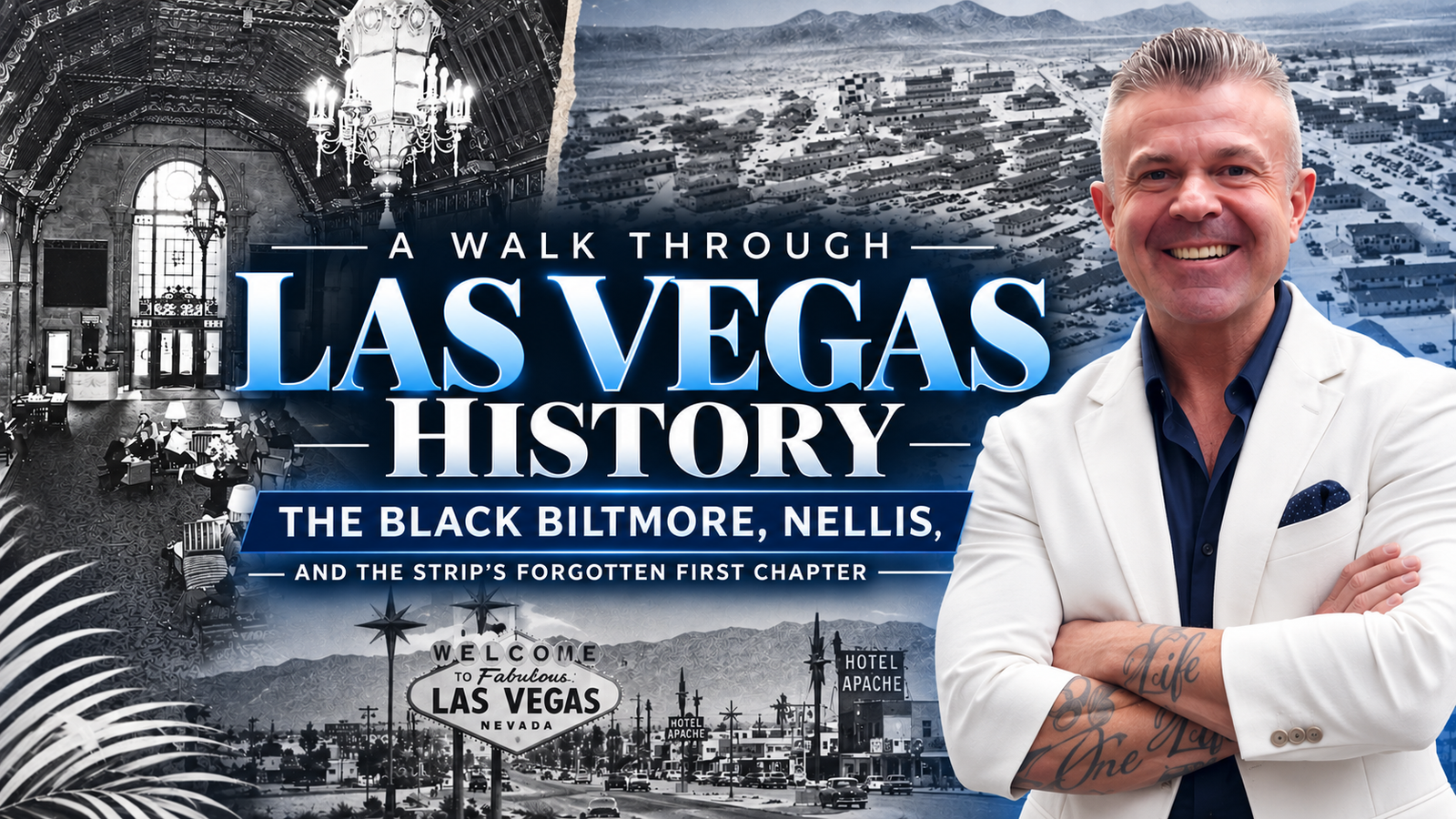
A Walk Through Las Vegas History: The Black Biltmore, Nellis, and the Strip's Forgotten First Chapter
For five weeks in 1949, a hotel on North Main Street quietly let Black patrons through the front door — until the city pulled its licenses. That made the Nevada Biltmore different from nearly every other establishment in the city, if only briefly. Locals started calling it the Black Biltmore, and then city officials shut it down.
That moment sits inside a Las Vegas history timeline that most residents have never fully traced. The valley's story starts earlier and runs stranger than the standard casino mythology gives it credit for.
May 15, 1905: A Railroad Auction Starts Everything
The date Las Vegas celebrates as its birthday is May 15, 1905. That morning, the San Pedro, Los Angeles & Salt Lake Railroad auctioned off 110 acres of desert — about 600 lots. The parcel ran from Stewart Avenue on the north to Garces Avenue on the south, Main Street to the west, and Fifth Street to the east.
The railroad company needed a stop roughly halfway between Salt Lake City and Southern California. Las Vegas had something most of the Mojave lacked: water. That underground supply made the site worth developing, and by the end of the auction's second day, roughly half the lots had already sold.
The city that grew from that auction is the same grid you drive today. Fremont Street, the federal buildings, the original block pattern — it all traces back to that two-day sale in 1905.
El Cortez and the Strip's First Resorts
By 1941, Fremont Street had its anchor. The El Cortez hotel-casino opened on November 7, 1941, and it is still operating today. It's the only currently operating Las Vegas casino listed on the National Register of Historic Places — the Moulin Rouge was actually added to the Register first, in 1992, but that building was gutted by fire in 2003, leaving El Cortez as the only one of the two still standing.
Out on what would become the Strip, the El Rancho Vegas had already opened on April 3, 1941, as the first resort on that stretch of highway. The Last Frontier followed in 1942, then the Flamingo in December 1946, and the Thunderbird in 1948. That four-hotel sequence from 1941 to 1948 is the foundation of the Las Vegas history timeline most people picture when they think of the city's rise.
The Nevada Biltmore's Five Weeks
The Nevada Biltmore hotel-casino, at North Main Street and Bonanza Road north of downtown, was actually one of that same wave of early resorts — it opened on June 20, 1942, alongside the El Rancho Vegas, El Cortez, and Last Frontier.
Seven years later, in 1949, new operators took over the property and announced their intention to be the first in Las Vegas to welcome the African American community — a direct challenge to the Jim Crow policies that governed virtually every casino in the city at the time.
City officials responded fast. After about five weeks of operating as what a contemporary Review-Journal account called "a colored resort," the Nevada Biltmore's liquor and gaming licenses were revoked, and the property was ordered closed on July 19, 1949. The episode was brief, but it mattered enough to locals that the name Black Biltmore stuck in community memory long after — not as a story of a policy that quietly lapsed, but of an integration attempt the city moved deliberately to shut down.
Nellis Air Force Base and the Northeast Valley
In the same period the valley's early resorts were opening, the federal government was also building out the Northeast Valley. The Army leased the land in January 1941, construction began that March, and the Las Vegas Army Air Field was activated and flying gunnery training missions by December 1941 — training aerial gunners through World War II and expanding steadily through the late 1940s. After a brief stint as "Las Vegas Air Force Base" starting in January 1948, the installation was formally redesignated Nellis Air Force Base on April 30, 1950, with a dedication ceremony on May 20, 1950 attended by the family of its namesake, Lieutenant William Harrell Nellis — a Las Vegas-area pilot killed in combat in 1944.
Nellis shaped the northeast valley in ways that still show up in the neighborhood map. The base brought a permanent civilian workforce, contractors, and military families who needed housing. Subdivisions that filled in east of the 95 and north of Washington Avenue over the following decades owe part of their density to that demand. If you own or rent in North Las Vegas today, the base's economic gravity is part of why that corridor developed the way it did.
Why It Still Matters Today
The Las Vegas history timeline is not just trivia. The 1905 auction explains why the original downtown grid runs the way it does, which still affects walkability scores and lot configurations in older neighborhoods near Fremont. The early Strip corridor explains why Las Vegas Boulevard carries the density it does, and why the surrounding residential streets developed as they did around those original resorts.
The Nevada Biltmore's brief, forcibly ended integration attempt — set against the harder segregation that defined most of the era — shaped which communities formed where across the valley. Those patterns took generations to shift and left marks on neighborhood boundaries that researchers and planners still reference.
Nellis anchored the northeast the same way Hoover Dam anchored Boulder City. Federal infrastructure creates civilian population, civilian population creates housing demand, and housing demand creates the neighborhoods people buy into decades later without knowing the original cause.
When you drive past the El Cortez on Fremont or spot the Nellis flight line from the 215, you are looking at infrastructure decisions made 75 to 120 years ago that still shape land values and neighborhood character today. Most cities have that kind of layering. Las Vegas just built its layers faster and stranger than most.
Frequently Asked Questions
What is the official founding date on the Las Vegas history timeline?
Las Vegas celebrates May 15, 1905 as its founding date. That is the day the San Pedro, Los Angeles & Salt Lake Railroad held a land auction for 110 acres that became the original city grid, bounded by Stewart Avenue, Garces Avenue, Main Street, and Fifth Street.
What was the Black Biltmore in Las Vegas?
The Nevada Biltmore opened in 1942 at North Main Street and Bonanza Road as one of the city's early hotel-casinos. In 1949, new operators announced plans to make it the first Las Vegas hotel-casino to welcome Black patrons, defying the city's Jim Crow norms. City officials revoked its liquor and gaming licenses after about five weeks, and it was ordered closed on July 19, 1949. The nickname Black Biltmore stayed in community memory afterward.
When did Nellis Air Force Base get its name?
The installation began as the Las Vegas Army Air Field, activated in December 1941 to train aerial gunners during World War II, and briefly renamed Las Vegas Air Force Base in January 1948. It became Nellis Air Force Base on April 30, 1950, honoring Lieutenant William Harrell Nellis, a Las Vegas-area pilot killed in combat in 1944.
Related reading
• The El Cortez: How the Oldest Hotel-Casino in Las Vegas Shaped Downtown's Story
• The Neon Museum: How Las Vegas Saves Its Own Story, One Sign at a Time
• The Forever 1 Memorial: How Las Vegas Is Building a Permanent Tribute to October 1